Home Insights White Papers Agentic AI in wealth management: Your transformation guide

Agentic AI in wealth management: Your transformation guide

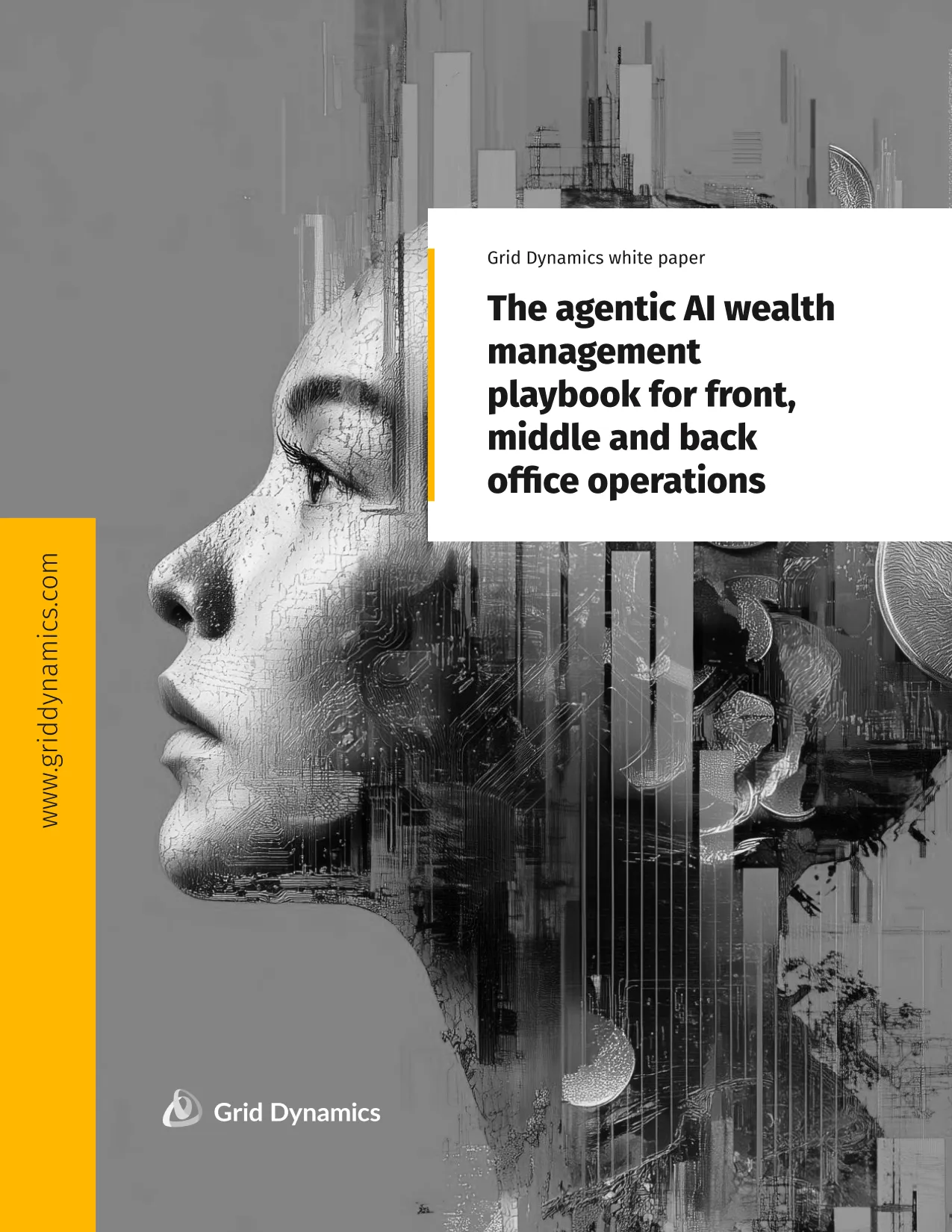
Cover of Grid Dynamics white paper about agentic AI wealth management playbook, featuring a stylized profile with circuit board overlay.

Wealth management firms face a critical challenge: operational costs ranging between ¢35 and ¢50 per $1 of revenue are eroding profitability. Agentic AI in wealth management addresses this by autonomously managing trade lifecycles from order processing through settlement, identifying investment opportunities and executing preliminary analysis, processing and responding to day one regulatory inquiries in hours, generating customized client reports from raw account data, and coordinating compliance monitoring across multiple systems. 

Download the white paper to explore how you can deploy these systems to reduce operational drag and enhance advisor productivity.​

Unlike rules-based automation, agentic AI wealth management systems provide intelligent orchestration across post-trade processing, regulatory remediation, and portfolio construction workflows. 

See how we helped a Fortune 500 wealth management firm achieve 30% reduction in manual effort while consistently meeting FINRA’s 24-hour response targets for regulatory inquiries through bitemporal database technology and autonomous compliance agents.​

Agentic AI efficiency across the wealth management value chain

Middle office functions are experiencing measurable ROI. AI agents now autonomously handle trade confirmation, settlement instruction generation, and reconciliation processes (previously manual, error-prone workflows that delayed T+1 settlement). In the white paper, you’ll learn how one large U.S. firm deployed agentic systems to automatically extract trade details and generate required documentation for clearing and custody operations.​

Back office transformation delivers even greater alpha. Advanced agentic QA systems aggregate data from unstructured sources such as emails, scanned documents, and third-party feeds while processing structured holdings, transactions, and positions data. 

These agentic AI wealth management systems execute deep research across disparate datasets, synthesize regulatory requirements from FINRA, SEC, and state regulators, and autonomously generate audit-ready compliance reports.​

Download the white paper to discover practical deployment strategies for agentic AI across client onboarding, portfolio management, alternative investment due diligence, and regulatory compliance operations.​

Tags

You might also like

AI agent visualization representing agentic AI in financial services white paper cover
White Paper
Agentic AI in financial services: Smarter data, governance, and deployment
White Paper Agentic AI in financial services: Smarter data, governance, and deployment

Agentic AI in financial services now touches fraud, AML, onboarding, investment suitability, and servicing. But with 76% of firms planning to implement agentic AI within the next year, the hard part is not the models themselves; it’s ensuring that the data, controls, and integration patterns with e...

Analyst guide: Bitemporality for data compliance white paper cover
White Paper
Bitemporality for data compliance
White Paper Bitemporality for data compliance

By Jason Bloomberg and Eric Newcomer, Intellyx Bitemporal data separates when something happened in your business from when your systems recorded it. For financial services firms managing regulatory reporting, audit requirements, and data quality challenges, this architectural approach provi...

Accelerating regulatory remediation with agentic AI and bitemporal data white paper cover
White Paper
Accelerating regulatory remediation with agentic AI and bitemporal data
White Paper Accelerating regulatory remediation with agentic AI and bitemporal data

Wealth managers, asset managers, and banks face mounting pressure when it comes to regulatory remediation—the process of responding quickly and accurately to inquiries from regulators like FINRA and the SEC. These demand answers to complex questions about past transactions, communications, and deci...

Cover of Grid Dynamics white paper on AI-driven digitalization of structured products
White Paper
Structured products: Harnessing AI-driven digitalization
White Paper Structured products: Harnessing AI-driven digitalization

Structured products are tailored financial instruments that combine traditional securities like bonds or stocks with one or more derivative components, offering investors customized risk-return profiles that standard investments can't match. Currently, the industry is at a technological...

Cybersecurity financial services
White Paper
Everything financial organizations need to know about cybersecurity in the cloud and DevOps era
White Paper Everything financial organizations need to know about cybersecurity in the cloud and DevOps era

Financial services face significant risks from cybercriminals due to insecure cloud and DevOps practices, leading to data theft, financial losses, and reputational damage. Download our whitepaper to discover effective strategies for securing your ecosystem, from identification and protection to res...

The future of the financial industry: 3 critical customer 360 and personalization trends
White Paper
The future of the financial industry: 3 critical Customer 360 and personalization trends
White Paper The future of the financial industry: 3 critical Customer 360 and personalization trends

The financial services industry is one of the fundamental pillars of the global economy. Given the broad spectrum of functions this sector performs, financial institutions have to stay on the edge of modern tech innovations, provide personalized experiences to their customers, and enhance their ope...

Grid Dynamics white paper cover titled ‘The architecture of intelligent interfaces’ with floating glass-like UI panels.
White Paper
The architecture of intelligent interfaces
White Paper The architecture of intelligent interfaces

Intelligent interfaces are changing how applications are designed and built, moving from fixed screens to systems that can restructure themselves around the way people actually work. Instead of just swapping content, intelligent user interfaces can decide which components appear, how they are a...

Let's talk

    This field is required.
    This field is required.
    This field is required.
    By sharing my contact details, I consent to Grid Dynamics process my personal information. More details about how data is handled and how opt-out in our Terms & Conditions and Privacy Policy.
    Submitting

    Thank you!

    It is very important to be in touch with you.
    We will get back to you soon. Have a great day!

    check

    Thank you for reaching out!

    We value your time and our team will be in touch soon.

    check

    Something went wrong...

    There are possible difficulties with connection or other issues.
    Please try again after some time.

    Retry