

What is AIOps?
AIOps (Artificial Intelligence for IT Operations) applies machine learning, big data analytics, and automation to IT operations. By continuously analyzing telemetry data (logs, metrics, traces, and events) from across the IT environment, AIOps platforms detect anomalies, correlate related events, predict failures, and trigger automated responses, helping teams resolve issues faster and prevent downtime.
AIOps vs. MLOps, DevOps, LLMOps, and Observability
AIOps sits at the intersection of AI, operations, and reliability, but it’s distinct from related fields that are often conflated. Understanding these differences clarifies what AIOps does and where it fits in your technology stack.
- AIOps vs. DevOps: DevOps automates software delivery (build, test, deploy). AIOps automates IT operations (monitoring, incident detection, and root cause analysis) using AI to keep production systems reliable.
- AIOps vs. MLOps: MLOps governs AI/ML system lifecycles (training, deployment, model monitoring, and drift detection). AIOps applies AI to broader IT operations (infrastructure health, application performance, and network issues) beyond just ML workloads.
- AIOps vs. LLMOps: LLMOps focuses on LLM-specific challenges (prompt management, guardrails, cost optimization). AIOps applies to all IT infrastructure (servers, networks, and applications) regardless of workload type.
- AIOps vs. Observability: Observability provides instrumentation and telemetry collection (logs, metrics, traces). AIOps layers AI-driven intelligence on top, using ML to detect anomalies, correlate events across systems, and automate root cause analysis.
AIOps architecture and core capabilities
An AIOps architecture typically consists of three layers: data ingestion (collecting telemetry from monitoring tools, cloud providers, applications, and infrastructure), AI-powered analytics (applying machine learning models to detect patterns and anomalies), and automation frameworks (triggering responses and orchestrating remediation workflows).
An AIOps platform unifies data across silos, breaking down barriers between infrastructure, application, network, and security teams.
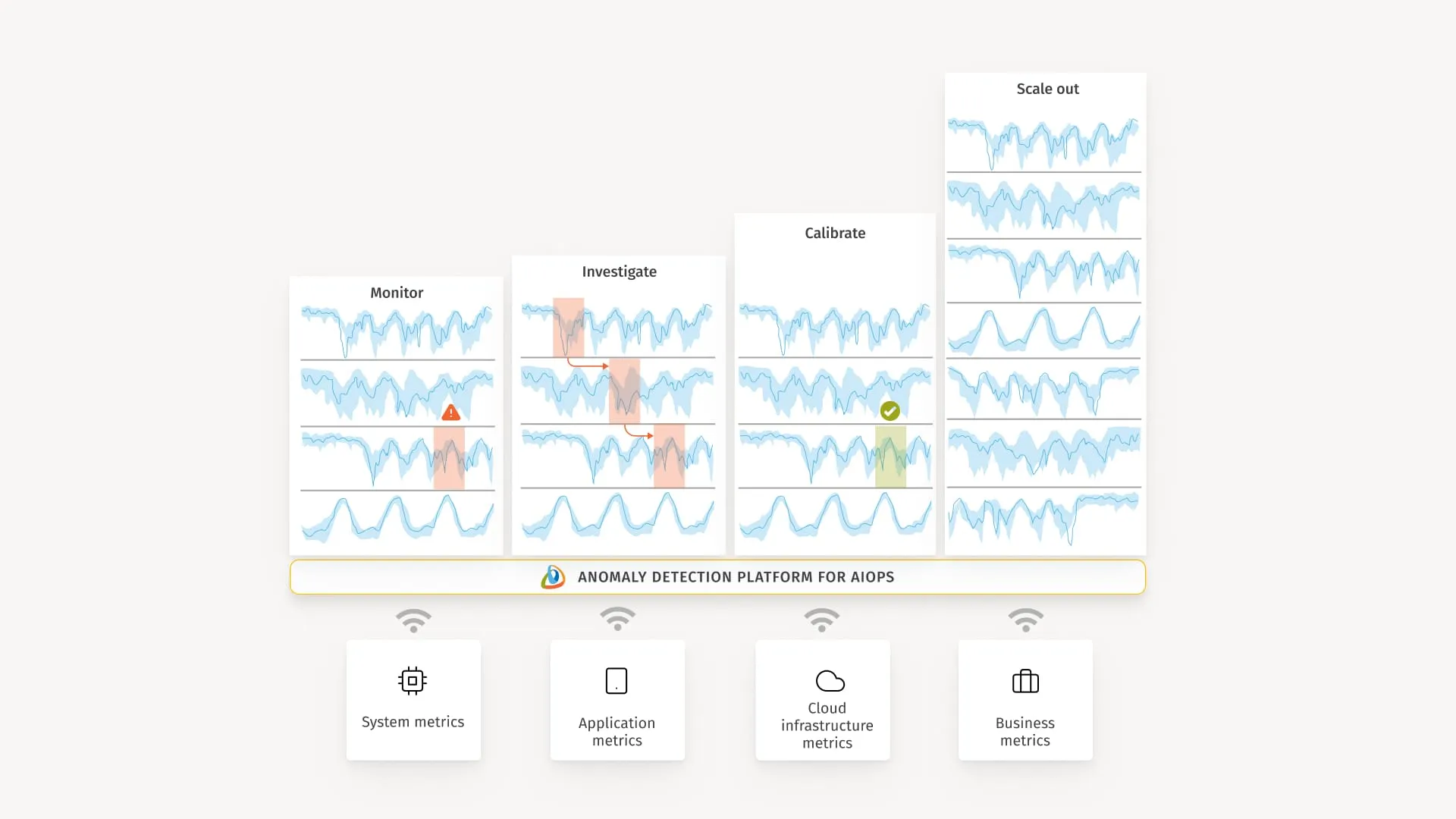
- Anomaly detection and pattern recognition: AIOps continuously analyzes metrics, logs, and traces to detect deviations from established baselines, identifying memory leaks, unusual traffic patterns, configuration drift, or performance degradation before they cascade into outages. Machine learning models adapt to seasonal patterns and business cycles, reducing false positives while catching genuine issues early.
- Event correlation and noise reduction: AIOps correlates related events across the monitoring stack, suppresses redundant alerts, and presents one actionable notification with full diagnostic context. This reduces alert fatigue and enables engineers to focus on resolution rather than investigation.
- Root cause analysis: When incidents occur, AIOps automatically traces dependencies across infrastructure, mapping how microservices, databases, and network components interconnect and pinpointing the actual cause, not just symptoms.
- Automated remediation and runbook automation: AIOps systems can trigger predefined workflows to resolve common issues automatically: restart a service, scale up resources, or roll back a faulty deployment. For complex problems, it assembles diagnostic data, suggests remediation steps to engineers, and creates incident tickets enriched with context.
- Predictive analytics for capacity and performance: By analyzing historical patterns, AIOps forecasts resource bottlenecks and performance degradation. This helps proactively scale infrastructure, balance workloads, and prevent slowdowns during peak demand.
- Observability data unification: AIOps consolidates logs, metrics, traces, and events from disparate tools into a single data lake. This single source of truth enables cross-functional teams to collaborate on incident response with shared context and consistent data.
AIOps use cases
AIOps delivers concrete value across operational domains wherever noisy alerts, complex dependencies, or real-time threats demand faster human response than traditional monitoring allows. Here are the most common scenarios where teams see measurable improvements in speed, accuracy, and engineering productivity.
- Incident management and alert optimization: Operations teams face thousands of alerts daily from tools like Datadog, Splunk, and cloud-native monitoring tools. AIOps clusters related alerts into single incidents, filters false positives, and routes them to the right teams with context. This reduces alert fatigue and cuts mean time to resolution (MTTR), which you can track and manage with an AI-powered engineering advisor.
- Cloud migration and hybrid infrastructure management: When enterprises migrate workloads to AWS, Azure, or Google Cloud, they face visibility gaps across hybrid architectures. AIOps maps dependencies between on-premises and cloud systems, establishes performance baselines in new environments, and automatically detects issues caused by architectural changes, such as misconfigurations, latency spikes, or resource contention. AI-powered observability capabilities surface migration risks and maintain operational continuity during transitions.
- Network security and threat detection: AIOps platforms analyze network traffic patterns, firewall logs, authentication events, and security telemetry to detect anomalies indicating potential breaches. By correlating behavioral patterns with threat intelligence, they identify DDoS attacks, unauthorized access attempts, data exfiltration, and infrastructure misconfigurations in real time, reducing threat response time from hours to minutes.
- Application performance monitoring in microservices: Distributed architectures generate complex traces spanning dozens of services. AIOps correlates distributed traces with infrastructure metrics, database query performance, and API response times to identify latency bottlenecks, resource contention, or cascading failures. This provides developers with precise optimization targets rather than requiring manual log analysis across services.
- Capacity planning and cost optimization: AI FinOps analyzes resource utilization trends, workload patterns, and business growth metrics to forecast infrastructure needs. By identifying underutilized resources, rightsizing opportunities, and optimal scaling thresholds, organizations avoid both over-provisioning (wasted spend) and under-provisioning (performance issues). Machine learning-based forecasting aligns infrastructure capacity with actual business demand.
AIOps solutions: Tools, platforms and evaluation
The AIOps market has been divided into distinct categories, each addressing a unique aspect of the operational puzzle. Rather than a single “best” tool, most enterprises combine multiple solutions to accomplish specific goals: monitoring and alerting, incident management, cloud operations, or cross-team orchestration. Understanding these archetypes helps you evaluate which platforms address your particular needs.
- Observability platforms with AI features: Tools like Datadog, Dynatrace, and New Relic have evolved from monitoring into full AIOps platforms. These tools collect telemetry data, use AI to analyze it, and provide combined dashboards with intelligent alerts to help identify the main issues.
- ITSM/IT operations platforms with AI automation: ServiceNow and Splunk ITSI integrate AI into IT service management, automatically creating tickets, enriching them with diagnostic data, and triggering workflows. These platforms connect the service desk with operational data to accelerate resolution.
- Cloud-native AIOps capabilities: AWS DevOps Guru, Azure Monitor, and Google Cloud Operations provide built-in AIOps for your cloud workloads. They analyze patterns in cloud metrics, detect anomalies, and recommend remediation without requiring third-party tools.
- SRE platforms and runbook automation systems: Specialized AIOps SRE platform with layers such as BigPanda and PagerDuty, focused on incident response, alert correlation, runbook automation, and cross-team workflow orchestration. These tools reduce on-call burden and ensure consistent incident handling.
How to evaluate the best AIOps platform for your needs
Selecting an AIOps platform involves aligning its capabilities with your operational maturity, data landscape, and risk tolerance. Use this framework to systematically evaluate vendors and confirm alignment with your infrastructure, team structure, and compliance requirements.
| Evaluation area | What to look for | Why it matters in practice |
| Data integration and coverage | Native support for your key data sources (cloud metrics, infra/app logs, traces, ITSM tickets, CI/CD events, security signals) and open APIs for custom sources. | AIOps analytics are only as good as the telemetry they ingest; data gaps (e.g., missing traces or ticket context) lead to missed incidents, weak correlations, and unreliable automation. |
| AI model transparency and controls | Explanations for anomaly detection and correlations (e.g., which signals contributed, confidence scores), tunable sensitivity, and human-readable rules layered on top of ML outputs. | Transparent AI enables SRE and ops teams to trust and tune the system rather than treat it as a black box, which is essential for root cause analysis, audits, and post-incident reviews. |
| Domain fit (general vs. specialized) | Option to choose domain-centric solutions (e.g., network-optimized, application APM–centric) or platform-level breadth across infra, apps, networks, and security. | Specialized AIOps can go deeper in a single domain (e.g., packet-level anomalies), while domain-agnostic platforms better support cross-stack incidents; most large enterprises need both and clear integration paths. |
| Automation depth and safety | Ability to execute existing runbooks, define new workflows, and gate actions with human-in-the-loop approvals before full autonomy. | Gradual automation (recommend → confirm → auto-remediate) reduces risk, lets teams validate behavior, and avoids unsafe “fire-and-forget” actions in complex production environments. |
| Support for modern/agentic workloads | Awareness of containerized, microservices, serverless, and AI/LLM workloads; ability to correlate infra issues with model/agent failures (latency, token limits, throttling). | Traditional AIOps often stops at VM and network metrics; modern stacks require an understanding of Kubernetes, service meshes, LLM gateways, and agent runtimes to capture the real impact path of an incident. |
| Observability and semantic context | Unified views over logs, metrics, and traces plus semantic context: dependency maps, service topology, change events, and deployment metadata. | Incident analysis depends on understanding “what changed where.” Topology and change-aware AIOps make it easier to distinguish real regressions from expected behavior shifts after deployments. |
| Policy, compliance and governance alignment | Integration with change management, access control, and policy-as-code (e.g., approvals for high‑risk actions, audit-ready event trails). | Enterprises need AIOps decisions to be explainable and auditable to meet internal policies and external regulations; consistent logging and policy enforcement prevent “shadow automation” that bypasses controls. |
| Scalability and performance | Proven ability to handle high event volumes, cardinality-heavy metrics, and large numbers of entities (services, clusters, regions) without degraded performance. | AIOps platforms can become a bottleneck if they cannot ingest and process production-scale telemetry; scaling limits manifest as dropped data, delayed alerts, or disabled features during peak times. |
| Integration with SRE and SDLC workflows | Hooks into incident management, on‑call scheduling, ticketing, CI/CD, and AI-enhanced SDLC workflows (e.g., surfacing operational insights into retrospectives and planning). | AIOps is most effective when it feeds directly into SRE practices, post‑incident reviews, and an AI‑native SDLC, creating a feedback loop from production back into design and implementation. |
| Outcome measurement and ROI tracking | Built-in reports for MTTR, MTTD, alert volume reduction, change failure rate, and availability SLOs, with baselines for before/after adoption. | Without measurable outcomes, AIOps becomes another tool rather than an operational improvement layer; explicit metrics help validate investments and guide tuning over time. |
AIOps works best when it complements SRE expertise, operational playbooks, and disciplined change management practices.