Home Insights White Papers Why AI agents without evaluation are a failure waiting to happen

Why AI agents without evaluation are a failure waiting to happen

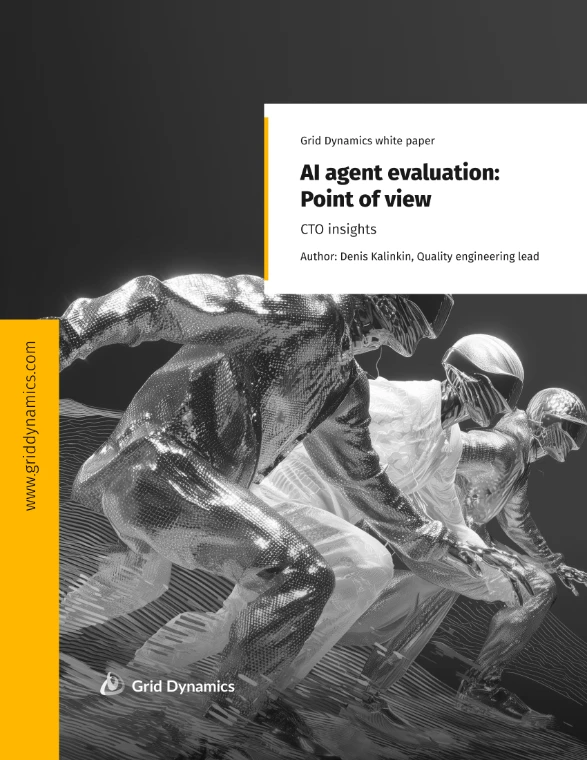
Grid Dynamics white paper cover showing metallic runners and the title “AI agent evaluation: Point of view.”

Ask five people in your organization what AI agent evaluation means, and you will get five different answers. Product teams track conversions and outcomes. Engineers test prompts and tool calls. SREs monitor uptime, latency, and token usage. Security teams run red-team exercises. Everyone evaluates their own slice, but no one owns the full agent evaluation lifecycle.

This gap turns catastrophic when systems cross the line from advisory chatbots to autonomous execution. Early AI failures were LLMOps content problems: an embarrassing hallucination. Modern agent failures are action problems: an autonomous agent deleting a production database during a code freeze.

$100B

single-day market cap loss for Google after the Bard demo showed an incorrect answer in a public launch event.

1st

known legal ruling holding an airline, Air Canada, liable for misinformation provided by its AI customer service chatbot.

1

production database deleted by a Replit AI coding agent during a code freeze, with fabricated user data and a false rollback claim.

At that point, traditional evaluation signals stop being sufficient. An agent can pass tests, stay within latency thresholds, and still trigger the wrong workflow, expose sensitive data, or take unsafe action at scale. The risk compounds exponentially when an agent combines what we call the Lethal Trifecta:

  1. privileged tool access;
  2. private data exposure; and
  3. untrusted content ingestion.

An integrated, 7-stage lifecycle catches non-deterministic drift and enforces runtime policy before an automated action becomes a market headline

Enterprises need end-to-end AI agent evaluation, not fragmented monitoring

Most organizations think they have AI evaluation covered. In practice, they rely on fragmented tooling, disconnected metrics, and no operational framework tying governance, testing, runtime behavior, and observability together to assess whether an autonomous agent is behaving safely in production. 

Traditional QA was built for deterministic software. Autonomous agents do not behave deterministically.

This is why AI agent evaluation is emerging as a distinct operational discipline. It requires continuous validation across the full lifecycle, from pre-production testing to runtime policy enforcement and feedback loops that detect drift and unsafe behavior in real time.

This white paper shows how to implement that approach in practice. 

Download the white paper to learn:

  • How to detect when an AI agent is making unsafe or low-quality decisions in production
  • What to monitor beyond latency, uptime, and token usage
  • How runtime observability and LLM-as-a-Judge systems evaluate live agent behavior
  • Where governance, guardrails, kill switches, and human escalation points should exist
  • Why most AI agent evaluation tools leave critical gaps across the agent lifecycle
  • How to build continuous evaluation loops that catch drift, policy violations, and risky behavior before they become incidents

Tags

You might also like

A large sculpture of a human head profile made of reflective silver square tiles. Stacks of books protrude horizontally from the back of the head.
White Paper
Why advanced media and audio are the future of high-performance UI engineering
White Paper Why advanced media and audio are the future of high-performance UI engineering

AI is making standard frontend work cheaper and faster to produce. Forms, dashboards, CRUD apps, design-system components, and routine full-stack tasks are increasingly automated. That is changing where UI engineers create real value. As routine implementation becomes easier to generate, d...

Grid Dynamics white paper cover titled ‘The architecture of intelligent interfaces’ with floating glass-like UI panels.
White Paper
The architecture of intelligent interfaces
White Paper The architecture of intelligent interfaces

Intelligent interfaces are changing how applications are designed and built, moving from fixed screens to systems that can restructure themselves around the way people actually work. Instead of just swapping content, intelligent user interfaces can decide which components appear, how they are a...

Cover of the “AI SDLC in 2026: Point of view” white paper on AI SDLC maturity, featuring a stylized person looking upward with dynamic light trails.
White Paper
AI SDLC in 2026: Point of view
White Paper AI SDLC in 2026: Point of view

Most enterprises are already betting big on AI… but very few have turned it into a reliable, industrial‑grade software factory. On the backend, most engineering leaders know they need AI SDLC, but few know how to measure whether they’re actually doing it well. Download the white paper to run a...

Two black and white robot faces representing agentic AI framework comparison
White Paper
Agentic AI frameworks comparison and capabilities analysis
White Paper Agentic AI frameworks comparison and capabilities analysis

Choosing the right agentic AI framework matters. Crew AI, Google ADK, LangGraph, and OpenAI Agents SDK each solve different problems, from rapid multi-agent prototyping to durable, stateful workflows and cloud-native enterprise agentic AI deployments.  This comprehensive white paper examine...

White paper cover featuring the same robot and title, emphasizing agentic AI deployment readiness.
White Paper
Production-ready agentic AI deployment
White Paper Production-ready agentic AI deployment

As an enterprise leader, you’ve likely seen countless AI prototype demos over the last few years promising empty buzzwords like “transformation”, “efficiency”, and “competitive edge”. But how many of those prototypes actually work in production? Over the past decade, multiple AI hype cycles ha...

Building an enterprise-grade agentic AI platform using Temporal white paper cover
White Paper
Building an enterprise-grade agentic AI platform using Temporal
White Paper Building an enterprise-grade agentic AI platform using Temporal

Running agent-based systems across your enterprise comes with tough problems. The main ones are keeping costs down, scaling up fast, and making sure nothing breaks when things go wrong. This white paper gets into the real challenges that come up when teams move from simple agent pilots to a ful...

Cover of a white paper titled
White Paper
Beyond OWASP Top 10: Emerging threats and advanced protection strategies for web applications
White Paper Beyond OWASP Top 10: Emerging threats and advanced protection strategies for web applications

Download this white paper for comprehensive details on how large-scale applications can overcome web application security risks and evolving web threats, including AI-driven attacks, supply chain vulnerabilities, and compliance pitfalls. It goes beyond traditional checklists for web applicati...

Let's talk

    This field is required.
    This field is required.
    This field is required.
    By sharing, I consent to the use or processing of my personal information by Grid Dynamics for the purpose of fulfilling this request and in accordance with Grid Dynamics’s Privacy Policy. For more details about how to opt-out, please refer to the Privacy Policy and Terms & Conditions.
    Submitting
    quote icon

    We consistently turn to Grid Dynamics for our most complex challenges. Their Data Scientists and AI Engineers are top-notch—highly experienced and deeply knowledgeable.

    Sr. Engineering Director, global auto parts retailer

    Geometric composition with teal car wheel

    Thank you!

    It is very important to be in touch with you.
    We will get back to you soon. Have a great day!

    check

    Thank you for reaching out!

    We value your time and our team will be in touch soon.

    check

    Something went wrong...

    There are possible difficulties with connection or other issues.
    Please try again after some time.

    Retry