





Auto parts e-commerce is booming, but complexity risks revenue. Think fitment accuracy, interchange precision, catalog and PDP content standardization, and omnichannel expectations. One misfit leads to a lost sale, and can even jeopardize customer safety.
Unique search pains in auto parts
Auto parts search is in a different league compared to typical retail categories like clothing, and it all comes down to catalog complexity. Automotive catalogs present unique challenges, including:
- Fitment complexity: A vehicle model can require dozens of compatible parts; Original Equipment Manufacturer (OEM) specifications, regional differences, and superseded or updated part numbers create a maze that even experts struggle to navigate.
- Data quality requirements: Enforcing standards like ACES and PIES across a patchwork of suppliers, while keeping naming consistent and interchange datasets robust enough for search, creates a massive, constantly shifting catalog.
- Massive data scale: Many parts fit up to 100,000 vehicle variations. Add omnichannel needs, and data volume quickly overwhelms legacy platforms.
- User experience: Buyers often submit vague, incomplete, or ambiguous queries, leading to mismatches, frustration, and abandoned carts.
- Dynamic inventory demands: Product availability changes in seconds; search must reflect real-time updates to avoid disappointing customers.
- Supplier catalog data chaos: Catalogs are fragmented, supplied in messy formats (PDF, spreadsheet, outdated systems), increasing time-to-market and eroding accuracy.
- Advanced merchandising needs: Teams need advanced, intuitive controls for automotive-specific campaigns and ranking to drive relevant results.
- Legacy limitations: The rigidity of conventional search platforms makes it harder to manage extensive, dynamic catalogs, resulting in slower response times and reduced search accuracy.
The solution: Google VAIS:C, MXP and GenAI Catalog Optimization
Grid Dynamics and Google integrated Google Vertex AI Search for Commerce (VAIS:C), the Merchandising Experience Platform (MXP), and GenAI-driven Content Catalog Optimization to deliver powerful, targeted solutions for every pain point. The combined solution operates as a SaaS engine built for extreme scale, indexing millions of product records and ingesting complex fitment, specification, and OEM metadata. It processes dynamic catalogs with millions of daily updates and provides instant, relevant results across retail channels. The architecture is cloud-native, containerized, and API-driven for fast integration and resilience.
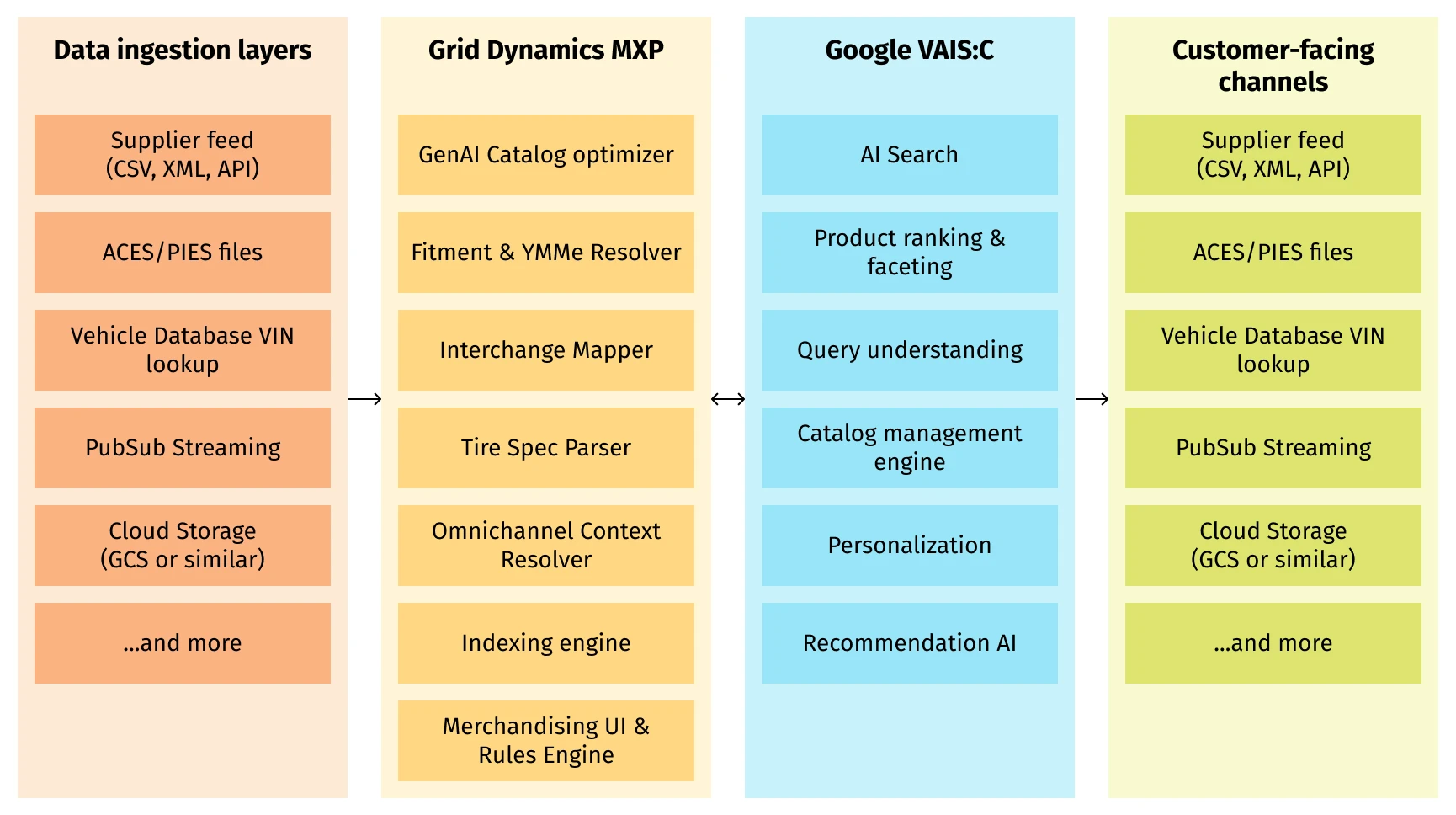
Data ingestion layers
The solution unifies supplier feeds in various formats (CSV, XML, API), industry-standard ACES/PIES files, VIN lookup databases, cloud storage, and real-time inventory streams, ensuring comprehensive, up-to-date data for automotive retail.
Grid Dynamics enhancement layer
The search enhancement layer powers automated catalog enrichment, exact Year-Make-Model (YMMe) fitment, compatible interchange mapping, and tire spec parsing for precision search. It also features logical omnichannel resolution, a custom indexing engine, and a dedicated merchandising UI and rules engine for more relevant search, campaigns, and product promotion for the auto parts market. Let’s have a quick look at the MXP and GenAI Catalog Optimization capabilities in more detail.
Advanced merchandising, accelerated

Using the MXP dashboard, teams can run fitment simulations, A/B test promotions, apply store-level inventory, and review performance analytics. No code is required so business users can orchestrate search campaigns and refine results instantly. Key features include:
- Store inventory sync: Local inventory is updated in near real-time for all channels.
- Debug profiler: Review rules and fitment structure, simulate vehicle scenarios, and filter by region or sub-model.
Catalog optimization that drives growth
Cleaner data leads to better search results. Customers get better suggestions, faster filtering, and more accurate results. Especially when they use natural language or vague queries.

Incoming data (PDFs, images, spreadsheets) enter a GenAI engine that extracts specs, applies ACES/PIES standardization, and creates enriched, unified records. Multimodal AI reads manuals and images, normalizes units and categories, and even generates high-fidelity product visuals when originals are missing. Key features include:
- Technical automation: High-confidence AI extractions are applied directly; low-confidence items are flagged for review.
- Onboarding team workflow: Interactive dashboards track change history, confirm normalization, and approve enriched records.
- Interchange management: AI identifies valid substitutes and part overlap, powering more relevant search and fewer dead ends.
Google VAIS:C
This layer delivers AI-powered search with advanced product ranking & faceting capabilities. It interprets natural language queries and manages extensive catalogs, while personalization features and recommendations AI further boost relevance, instantly connecting every shopper to the right part and driving discovery of related items.
Customer-facing channels
Shoppers enjoy a unified, responsive experience across web, mobile, in-store kiosks, and conversational AI assistants, all fueled by real-time data.
Fitment problem, solved.
“Will this part fit my vehicle?” This is the question that defines auto parts search.
VAIS:C and Grid Dynamics parse the most granular fitment blocks, handling 100,000+ combinations per SKU. Fitment data is indexed at both parent (product) and child (compatibility) levels for accurate results.

The parent product with child fitment blocks detail year, make, model, sub-model, engine, and OEM variant. At query time, users can specify details in UI selectors or add vehicles directly, ensuring guaranteed compatibility is displayed at every product page. Advanced logic allows implicit fitment matching: queries like “2008 chevrolet bolt spark plug” trigger automatic filtering using structured fitment criteria, not broad recall.
MXP boosts precision by extracting vehicle attributes from unstructured queries, applying conditional filters for fit, and pushing campaigns to highlight best-match inventory.

We share similar techniques in this blog, Semantic query parsing blueprint, however, we’ve since enhanced these techniques, while still preserving VAIS:C’s original query understanding capabilities.
The solution also parses complex tire specs (“18055 R17,” etc.) and cross-references them with compatible vehicles. This eliminates dead ends and ensures even niche queries find relevant stock or verified alternatives.

The journey from browse to buy, refined
When VAIS:C, MXP and GenAI Catalog Optimization work together, the “will this part fit my vehicle?” challenge hits the road, and buying journeys become smooth and fast.

Real-world impact
This architecture is already live and driving measurable results:

- Faster, more reliable search response
- Higher conversion rates due to fitment accuracy and confident purchasing
- Streamlined merchandising, less time lost on manual fixes
- Deeper analytics, driving smarter business decisions
Adaptable to industry progression
Our approach adapts alongside auto parts and EV trends. As vehicle technology and models change, the platform expands schema, adds predictive maintenance, and modernizes conversational, visual, and predictive shopping assistants.
Conclusion
The auto parts sector faces complexity and operational demands that exceed traditional retail requirements. Google VAIS:C and Grid Dynamics’ automation stack solve every problem at scale, from catalog chaos to merchandising velocity. Fitment is accurate. Data is clean and fast. Merchandising is continuous, creative, and precise.
Ready to deploy?
Contact Grid Dynamics and Google for a tailored PoC and see the new standard in action, before the market leaves legacy search behind.

Interested in this topic?
Authors
You might also like