




As of February 2026, the European Union Artificial Intelligence Act (AI Act) has transitioned from a legislative draft to the primary regulatory framework for software engineering in the EU. This landmark legislation is no longer a distant prospect; with prohibitions on unacceptable risks already in force since 2025 and the full application of high-risk and transparency requirements set for August 2026, engineers must now treat EU AI Act compliance as a core functional requirement for safe AI deployments.
For detailed verification of these milestones, see Article 113: Entry into force and application.
What are the EU AI Act risk tiers?
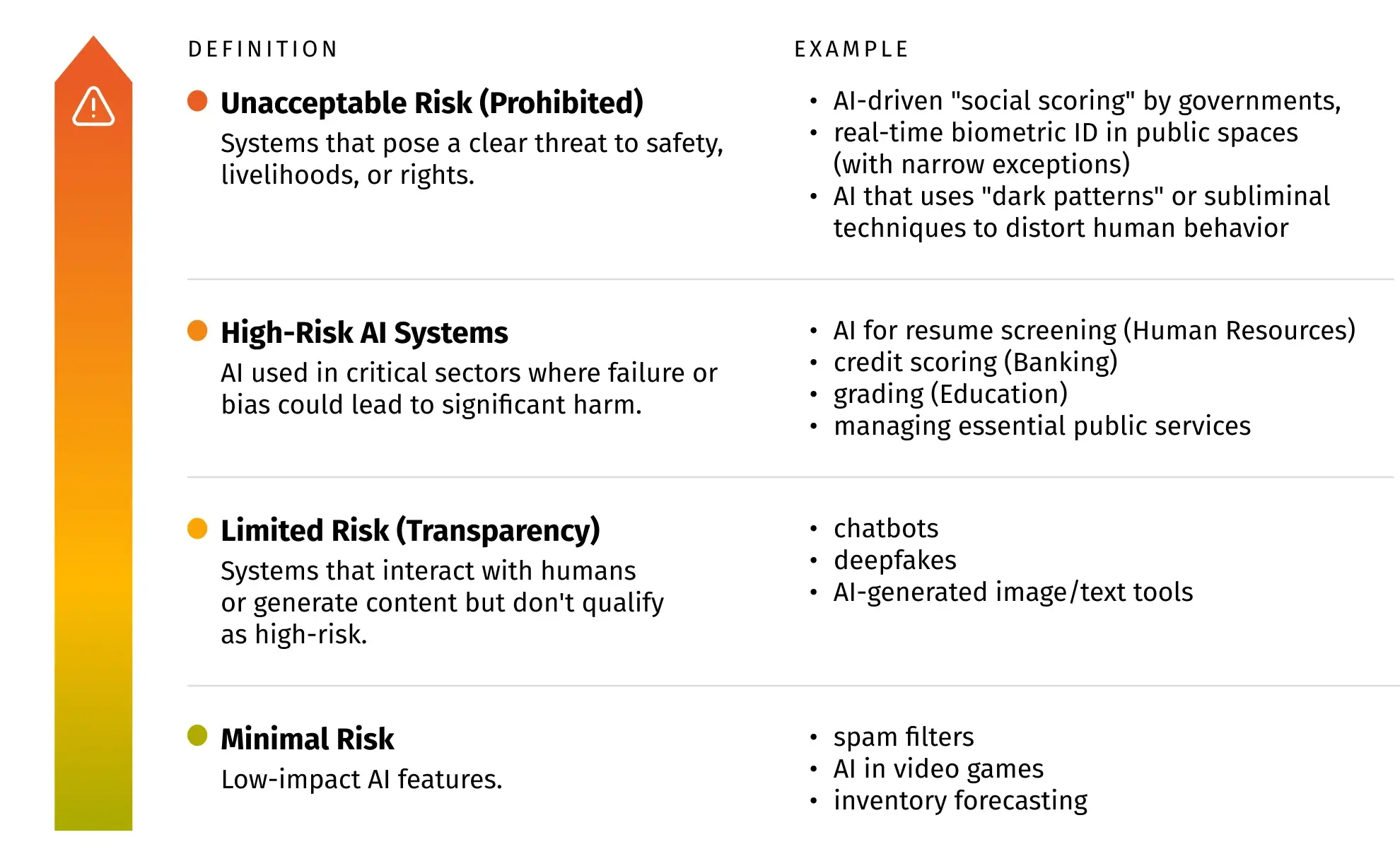
The AI Act moves away from regulating “AI” as a broad category and instead regulates the specific use case. It defines four core compliance risk tiers: unacceptable, high, limited, and minimal risk. The risk tiers range from outright bans and stringent logging to targeted transparency UI patterns and light-touch governance. Your engineering roadmap is dictated by where your feature falls in the risk hierarchy:
Unacceptable risk (Prohibited)
- Definition: Systems that pose a clear threat to safety, livelihoods, or rights.
- Prohibited features: AI-driven “social scoring” by governments, real-time biometric ID in public spaces (with narrow exceptions), and AI that uses “dark patterns” or subliminal techniques to distort human behavior.
- Engineering impact: Features in this category are illegal in the EU. Codebases must be audited to ensure no manipulative “nudges” are powered by autonomous logic.
High-risk AI systems
- Definition: AI used in critical sectors where failure or bias could lead to significant harm.
- Examples: AI for resume screening (Human Resources, Annex III Point 4 (a)), credit scoring (Banking), grading (Education), or managing essential public services.
- Engineering impact: Subject to the most intense requirements: mandatory data governance, automated logging, detailed technical documentation, and human-in-the-loop oversight.
Limited risk (Transparency)
- Definition: Systems that interact with humans or generate content but don’t qualify as high-risk.
- Examples: Chatbots, deepfakes, and AI-generated image/text tools.
- Engineering impact: Primarily frontend-focused; requires explicit disclosures and machine-readable metadata.
Minimal risk
- Definition: Low-impact AI features.
- Examples: Spam filters, AI in video games, or inventory forecasting.
- Engineering impact: No mandatory legal obligations, but voluntary “Codes of Conduct” are encouraged to maintain brand trust.
UI design & frontend obligations for EU AI Act compliance
This section is specifically tailored for Frontend Engineers and UI/UX Designers. Under Article 50, the burden of “Transparency” is largely technical, requiring specific interface components and metadata standards to ensure users are never misled by AI.
Below are the five core obligations from Article 50, translated into engineering requirements:
A. Human-AI interaction disclosure
The requirement: If a user is interacting directly with an AI, they must be informed immediately.
- The nuance: This does not apply if it is “obvious from the points of view of a reasonable user.” However, in modern web design where bots mimic human speech patterns, the “obviousness” threshold is high.
- Engineering implementation:
- Persistent indicators: Don’t just show a toast notification at login. Maintain an “AI Assistant” badge in the header or a persistent disclaimer in the chat input field.
- Example: A placeholder in the input field: Ask our AI assistant a question… and sub-text: Automated response generated by [Model Name].
B. Synthetic content marking & detection
The requirement: Providers of AI systems that generate audio, image, video, or text must ensure that the outputs are marked in a machine-readable format and detectable as artificially generated.
- Engineering implementation:
- Metadata embedding: This is a backend-to-frontend pipeline task. You must use standards like C2PA or IPTC metadata to embed “AI-generated” tags directly into the file headers.
- Machine-readable requirements: The marking must be “interoperable, effective, and robust.” It should survive common frontend transformations like image resizing, format conversion (PNG to WebP), or compression.
- Text exception: This doesn’t apply if the AI only performs assistive functions like spell-check or formatting, provided it doesn’t substantially change the content.
C. Emotion recognition & biometric categorization
The requirement: If your application uses AI to sense a user’s emotions (via webcam/voice) or categorize them based on biometrics (e.g., age, gender, or race detection), the user must be informed.
- Engineering implementation:
- Explicit disclosure: Before the browser requests camera or microphone permissions, a custom UI modal must explain that an AI is analyzing their emotional state and why.
- Example: “This application uses AI to analyze your facial expressions to determine your engagement level during the test.”
- Constraint: This must comply with GDPR (consent-based) in addition to the AI Act’s disclosure rules.
D. Deepfake disclosure
The requirement: Users of AI that generate “deepfakes”—content that appears real but is artificially manipulated—must disclose that the content is artificial.
- The “clear and distinguishable” standard: The disclosure cannot be hidden in a “Terms of Service” page. It must be on the content itself.
- Engineering implementation:
- Overlays: For video content, implement a non-removable watermark or a persistent corner overlay.
- Audio triggers: For audio-only apps, implement an “Audible Disclosure” (e.g., “This voice is AI-generated”) at the beginning and end of the playback.
E. Text for public interest
The requirement: If an AI generates or edits text intended to inform the public on matters of public interest (e.g., news, political opinions, or social issues), the fact that the text is AI-generated must be disclosed.
- Engineering implementation:
- Content tagging: Every article or post generated by AI must have a prominent “AI-Generated” or “AI-Assisted” label near the byline.
- Exception: This does not apply if the content has undergone “human review or editorial control” and a natural person holds editorial responsibility.
Exceptions to transparency
It is important for engineers to know where these rules do not apply to avoid over-engineering:
- Law enforcement: Systems authorized by law for detecting or investigating criminal offenses.
- Creative/artistic works: If the AI-generated content is part of an “evidently creative, satirical, artistic or fictional work,” the transparency obligations are limited to a level that does not hamper the display of the work (e.g., a credit roll or small icon).
Technical architecture: The “evidence layer”
Compliance for high-risk systems requires an immutable backend that can prove the system’s safety to regulators.
A. Automated record-keeping
High-risk systems must automatically record events throughout their lifecycle. See bitemporal financial audit regulatory compliance, for example.
- The compliance schema: Standard system logs are insufficient. Your database must capture:
- Period of use: Exact timestamps of every session.
- Reference database: The version of the training/testing dataset used.
- Human-in-the-loop ID: If a human reviewed the output, the log must capture the ID of the reviewer.
- Verification identity: Proof that the reviewer was a qualified natural person.
B. Explainability & instructions for use
High-risk systems must be “sufficiently transparent” to enable users to interpret outputs.
- Transparency dashboards: Instead of static PDFs with legacy documentation, modern apps use an integrated view showing the model’s accuracy, its known limitations (e.g., “Accuracy drops by 12% in low-light conditions”), and its intended purpose.
C. Robustness & cybersecurity
Backend teams must implement specific safeguards against prompt injection and data poisoning. The Act requires systems to be “resilient as regards errors, faults or inconsistencies.”
- Implementation: Integrating automated “red-teaming” tools into the CI/CD pipeline to test the AI’s boundaries before every deployment.
EU AI Act compliance checklist for engineering teams
Phase 1: Risk & data governance
- ☐ Risk classification: Map your features against Annex III. Is this high-risk?
- ☐ Data quality (Article 10): Are your training/validation datasets relevant, representative, and “to the best extent possible, free of errors”?
- ☐ Bias mitigation: Does the data pipeline include automated tests for historical or demographic bias?
Phase 2: Technical documentation & logging
- ☐ Technical file (Article 11): Do you have a living document describing the system architecture and logic?
- ☐ Automated logging (Article 12): Does your backend capture the specific metadata required for traceability?
- ☐ Post-market monitoring (Article 72): Have you implemented a plan to track the system’s performance after release?
Phase 3: Human-machine interface (UI)
- ☐ AI disclosure (Article 50): Is the AI interaction clear at the point of entry?
- ☐ Human oversight (Article 14): Is there a “Human Override” or “Kill Switch” button in the UI for high-risk decisions?
- ☐ Deepfake labeling: Is manipulated media labeled “in a clear and distinguishable manner”?
Phase 4: Safety & security
- ☐ Accuracy metrics (Article 15): Is the system’s performance (accuracy, robustness) documented and visible to the user?
- ☐ Cybersecurity: Has the system been hardened against prompt injection and model extraction attacks?
‼️To ensure your specific feature set meets these rigorous standards, it is highly recommended to cross-reference your architecture with the official AI Act Compliance Checker Flowchart v1.0. This technical resource provides a step-by-step logic path for identifying your exact legal obligations.
Conclusion
The EU AI Act signals the end of “unseen” AI. For engineering teams, the shift is from pure optimization to verifiable safety. By building these “Compliance by Design” patterns into your architecture now, you ensure your application is not only legal but “Trustworthy” by the standards of the world’s most significant digital market.
Interested in this topic?
Authors
You might also like