





User interfaces are no longer static. The industry is shifting toward adaptive systems where the interface is assembled at runtime. For decades, software was designed around fixed surfaces: a nav here, a hero there, content slots predefined by a designer. Users learned the interface.
However, the advancements in AI changed that dynamic. LLMs introduced personalization at scale, but early integrations kept the structural contract intact. The layout stayed constant; AI filled the content slots. Adaptive UI takes it a step further, reshaping the interface itself.
This marks a clear inversion in how software works. Instead of forcing users to adapt to predefined interfaces, the interface adapts to the user. At the same time, most adaptive systems today still operate within a limited, human-defined set of UI patterns. The interface can adapt and personalize, but only within constraints defined by designers.
As interfaces become adaptive, validation can’t stay tied to fixed pages. The UI is dynamic, but validation is still built for static layouts. In this blog, we explore how validation evolves in this new model, shifting from testing pages to validating components, contracts, and runtime assembly.
The shift from fixed interfaces to adaptive systems
Adaptive UI breaks the fixed-frame assumption entirely. The interface now learns from the user. AI agents are now the architects of the layout. The interface is no longer a persistent container; it’s a variable, generated at runtime based on user intent. What used to be a constant frame is now a system-generated output.
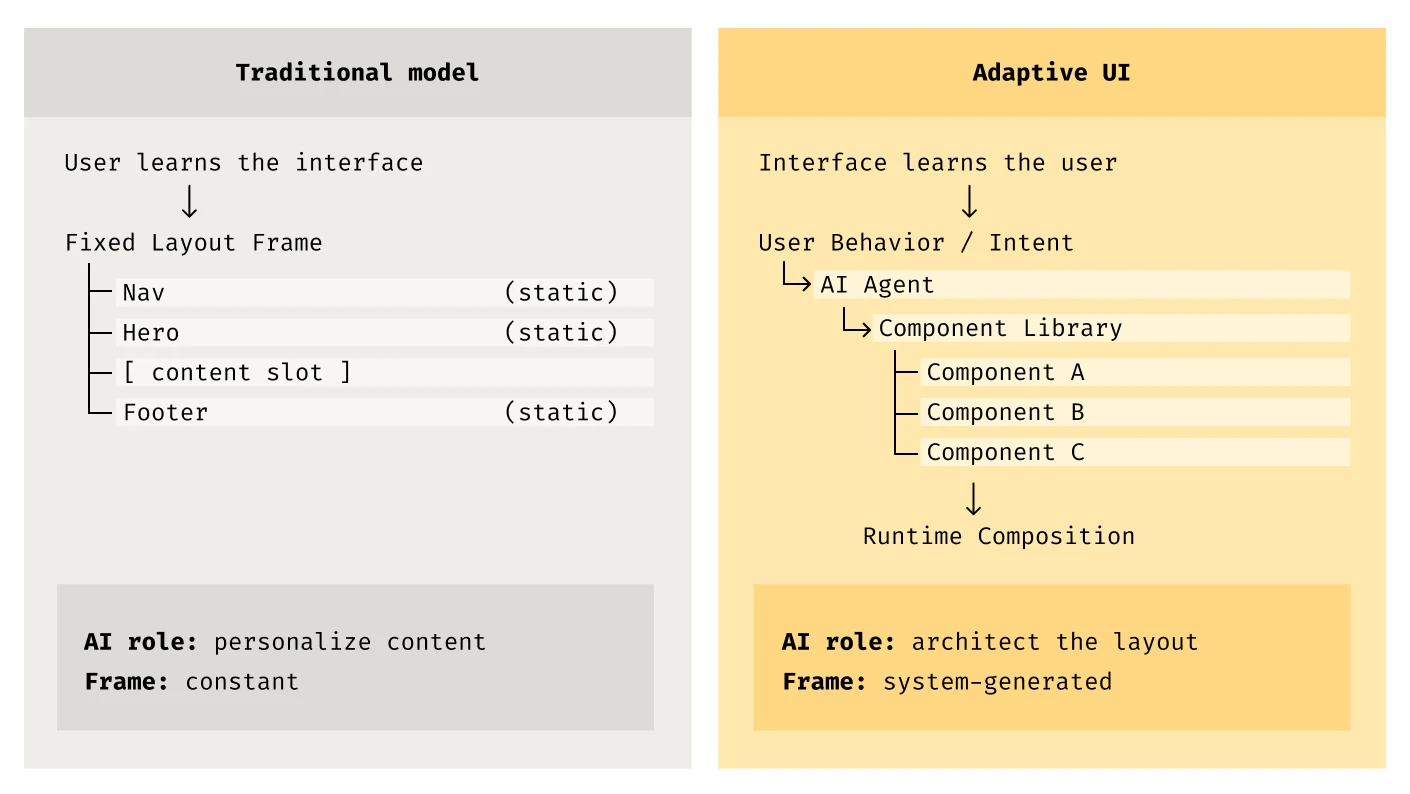
Traditional end-to-end (E2E) testing validates fixed user paths through persistent frames. This approach breaks down when an AI agent assembles the interface dynamically. You can’t path-test a layout that didn’t exist at design time. Validation must shift focus from the final “page” to the building blocks: the component model and the contractual rules governing how they assemble.
How validation changes when interfaces are built at runtime
Adaptive UI shifts the validation target from pages to components, demanding a framework built around three interlocking concerns:
- Component vocabulary: Ensuring each building block is sound and reliable
- Agent–component contract: Governing how agents interact with components
- Scalability and maintainability: Keeping the system consistent as the library grows
These concerns come together in three core pillars: Structural integrity, Contractual reliability, and AI-accelerated engineering.
Structural integrity and environmental fidelity
The best way to prevent errors in agent-assembled interfaces is to catch them before assembly happens. Verify components in isolation: each building block should be compliant and sound on its own, before the agent ever touches it. Component logic and behavior are fixed at design time; the agent chooses which components to use and what props to pass. That separation is what makes isolation testing meaningful.
Structural decomposition
Validation follows atomic design principles: Atoms, Molecules, Organisms, Templates.
Each level is verified independently. Think of it like load-bearing walls in a building: fix the structural issues at the foundation, and everything built on top stays sound. Atoms, Molecules, and Organisms form the component vocabulary the agent selects from.
Templates are the pre-designed layout variants that vocabulary assembles into. Each one is validated as a complete structural option before the agent ever picks between them at runtime.
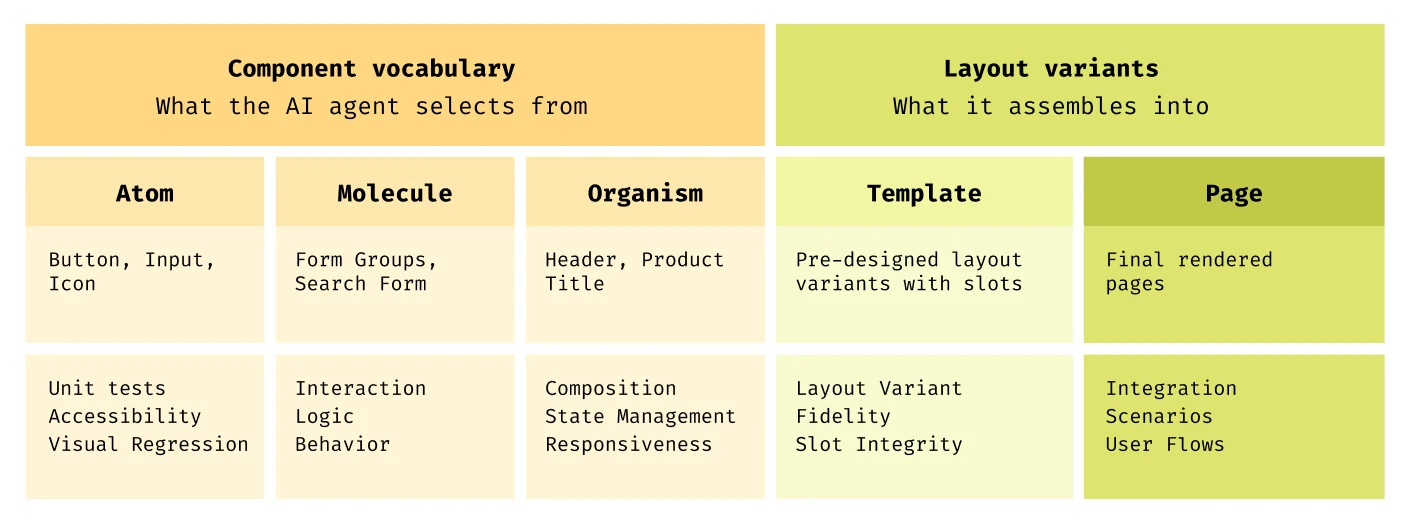
Native engine execution
Node-based emulators can be misleading. They can’t accurately calculate z-index layering, CSS collisions, or real layout dimensions. That’s the “simulation gap”, and it’s especially dangerous in dynamic UIs where no human pre-verifies the assembled layout. Running components in actual browser engines closes that gap. Event bubbling, rendering performance, and layout logic are all verified at 100% production fidelity.
Contractual reliability and semantic alignment
In an Adaptive UI, the agent communicates with the component library via declarative schemas. That makes the schema the contract. The contract has two failure modes: what components communicate to the agent, and what they receive from it. Both must be tested.
This pattern is gaining traction beyond single-agent systems. Google’s A2UI protocol uses the same declarative approach to enable safe UI generation across agent boundaries: Agent A generates a surface, Agent B renders it, and neither knows the other’s implementation. The schema is the only contract between them.
Contract integrity & semantic verification
The agent selects components by ID, passing typed props and expecting outputs that match its intent—semantically, not just visually. That requires two things to be true.
- Components must speak in functional descriptors: semantic tokens that carry intent, ARIA roles that describe function.
- Accessibility requirements must be baked in. Compliance isn’t a post-check; it’s the contract. A component that enters the library non-compliant doesn’t just fail one screen; it fails every layout the agent assembles from it.
Neither guarantee holds permanently. A token rename, a theme update, or a dependency bump can silently violate visual boundaries or break consistency across layout variants. Every PR is a compliance checkpoint: a standing verification across all contract layers.
Payload resilience & logic isolation
Semantic correctness covers what components communicate. Payload resilience covers what they receive. LLMs don’t always output what you expect: markdown where there should be plain text, wrong data types, or content that blows past a component’s length constraint. We deliberately test building blocks against these probabilistic inputs.
The other side of that resilience is isolation. Business logic and the visual layer must stay strictly separate. The AI modifies presentation, never the underlying rules and data. Every component relies on a defined API, with no internal state management embedded in the UI element.
Keep the layers separate. The assembly engine can then reconfigure layouts freely, without touching the data underneath.
AI-accelerated engineering and maintenance
Enforcing contracts at scale requires more than discipline. A large component library generates thousands of permutations. Manual verification can’t keep up. So the framework turns AI on the problem itself, using an AI-assisted loop to generate tests, maintain them, and free engineers to govern rather than script.
AI-assisted generative workflow
This works because the component library is designed for AI consumption from the start. Components carry semantic metadata: structured intent, constraints, and relationships that agents can actually read. Canonical reference specs and Atomic architecture keep context windows clean so agents produce higher-accuracy output.
With that foundation in place, agents can do real work. They fetch reference specs and design system rules. The component vocabulary stays covered: LLM-assisted generation produces boilerplate and edge-case logic automatically as components are added or updated. Generated code is validated against linters and type systems before it runs.
Human-in-the-loop: From authoring to governing
Automation inverts the engineering role. As the framework handles generation and maintenance, the quality engineer stops being a script author and becomes an architect of quality gates. The shift is from checking outputs to defining quality gates and ensuring the component vocabulary is resilient enough for any configuration the agent might choose. The machine handles the permutations. The human sets the boundaries that make them safe.
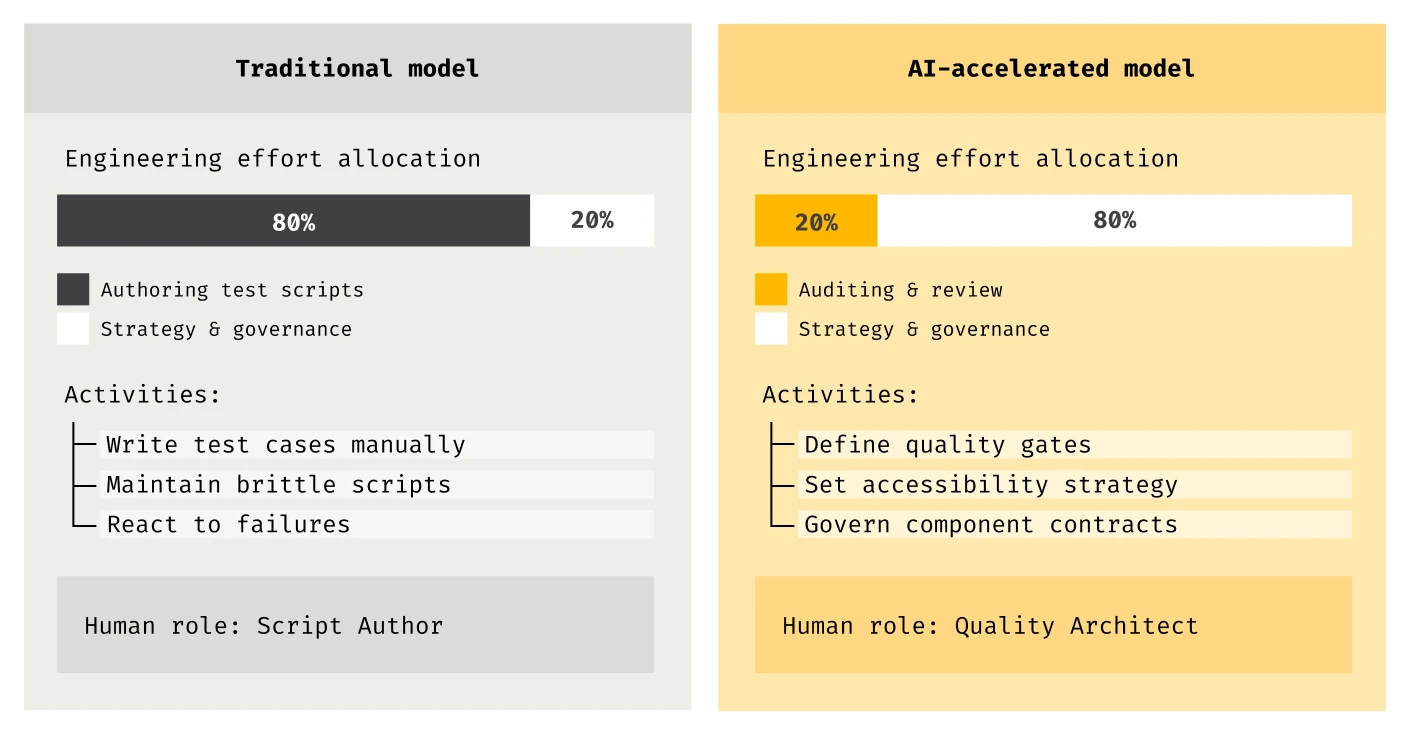
This delivers three key outcomes:
- Any layout the agent assembles is structurally sound by design. A validated component library gives AI agents a safe vocabulary to build from, with no unsafe components entering the assembly at runtime.
- Interfaces stay compliant and resilient before they reach the agent. Accessibility audits run at the component level, and components are validated against the full range of inputs an LLM can generate.
- AI generates coverage the team could never produce manually—thousands of component permutations validated automatically, with engineers governing quality gates instead of authoring scripts.
Conclusion
We’ve found that validating the building blocks, not the final frame, is what keeps quality intact at scale. Prioritize the integrity of the component vocabulary, enforce strict semantic contracts, and deterministic standards become achievable even in a non-deterministic environment.
This framework makes assembly safe by design. The next frontier is validating the assembled output itself: composition coherence, intent fidelity, and runtime accessibility across the full surface.
Reach out to us if you’d like to learn more about adaptive UI, validation frameworks, and how to make AI-assembled interfaces reliable in production.
Interested in this topic?
Authors
You might also like