






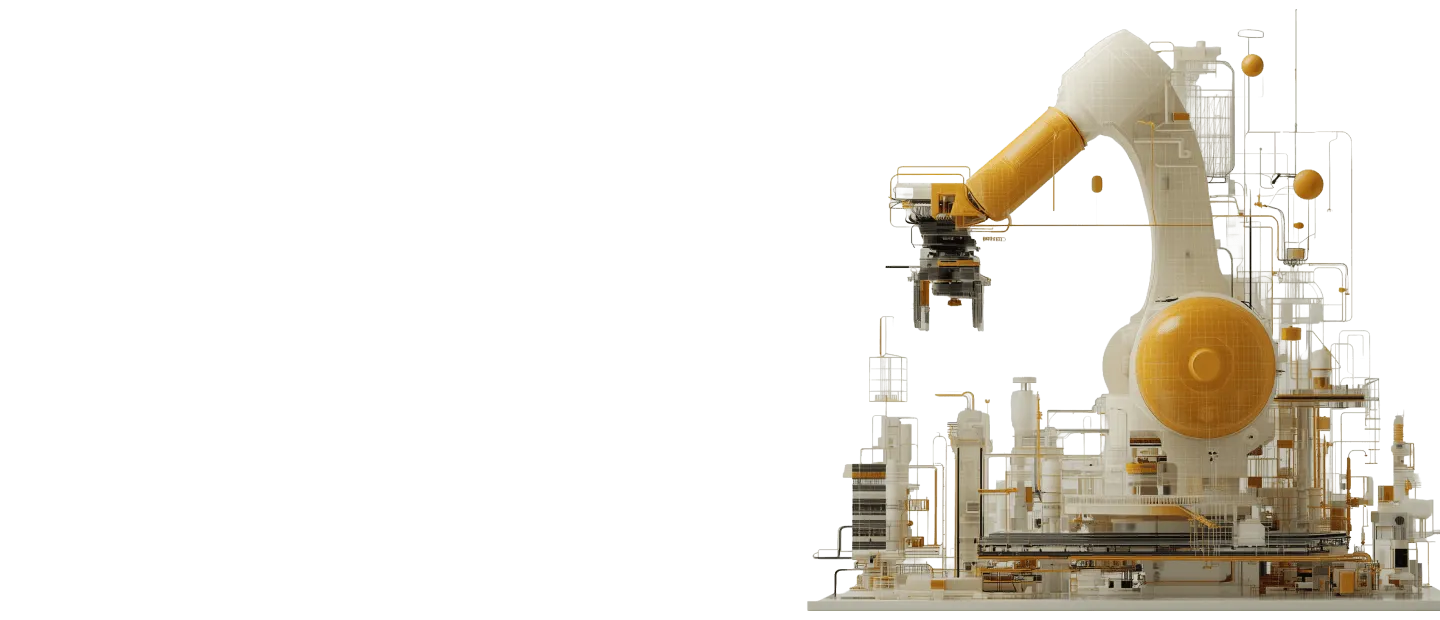
See digital twin software in action
Building complex robotic assembly lines requires advanced tools to program, test, and optimize multi-robot workflows.
This demo shows how NVIDIA Omniverse enables end-to-end optimization using high-fidelity digital twins. Engineers can program robotic cells, simulate full production workflows, test computer vision with virtual cameras, and validate changes before deployment.
By connecting simulation, control systems, and physical equipment into a continuous improvement loop, teams can orchestrate manufacturing cells, accelerate cycle time optimization, and safely validate layout changes.
Capabilities
Reduce risk, accelerate innovation, and maximize throughput with a closed-loop system that continuously learns and improves.

INTEGRATED OPTIMIZATION & SCHEDULING
Connect planning systems with simulation-driven validation
Integrate state-of-the-art simulation software such as NVIDIA Omniverse or Siemens Tecnomatix directly with your customer solvers, production schedulers, ERP/MES systems, or AI routing algorithms.
Create a closed-loop system where data-driven mathematical models are continuously validated and refined through realistic, high-fidelity 3D simulations.
ROBOTIC CONTROL & ORCHESTRATION
Validate robotic workflows and computer vision systems
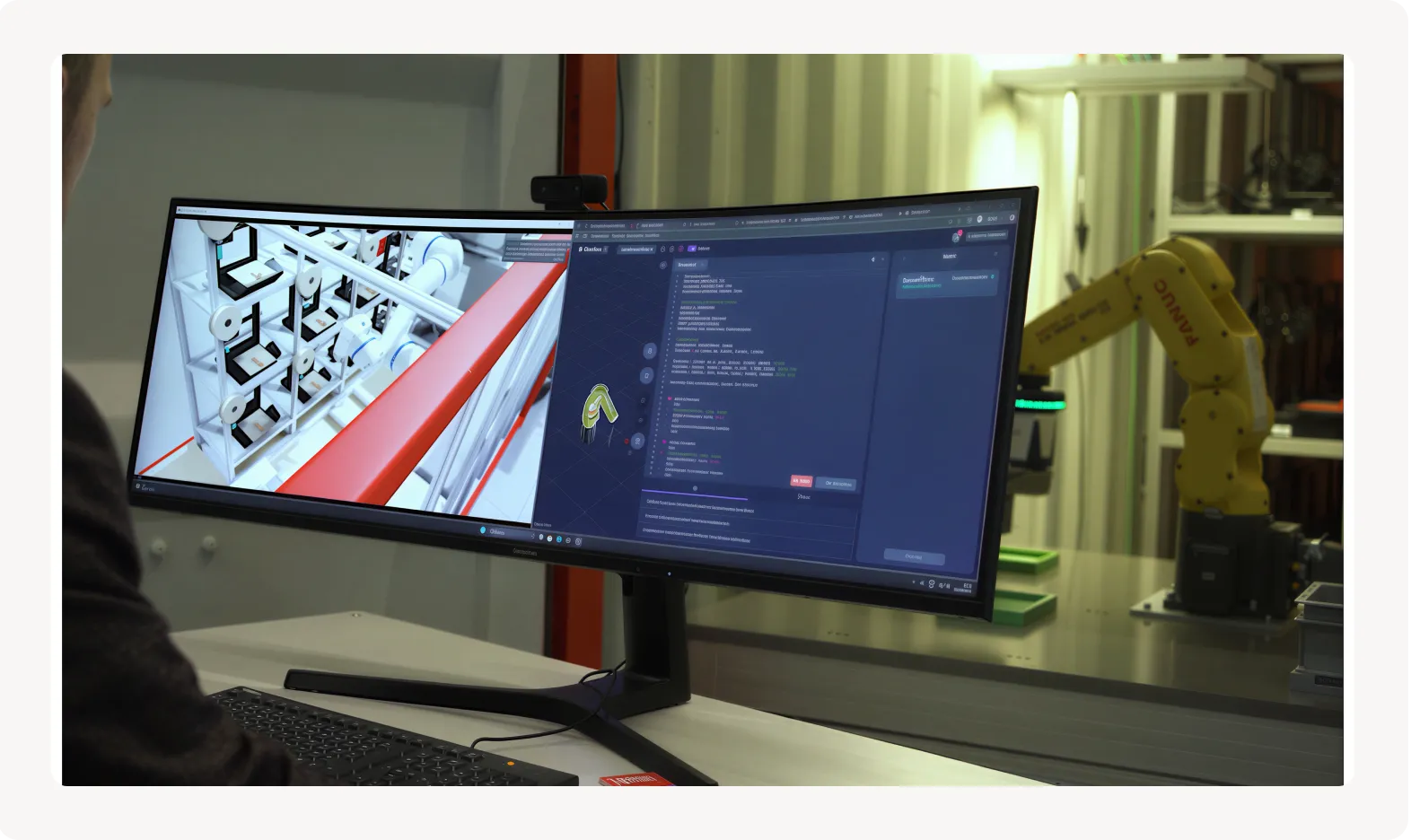
Connect the digital twin with robotic control systems and programming tools to simulate real production environments.
Program individual robotic cells, test computer vision components using realistic virtual cameras, and simulate entire assembly lines, ensuring seamless orchestration and collision-free motion across multiple manipulators and AGVs.

PHYSICALLY ACCURATE SIMULATION
Stress-test operations with real-world physics
Go beyond abstract, event-based models by leveraging high-fidelity physics simulation.
Model exact movement paths, friction, payload mass, acceleration, and environmental constraints to uncover hidden bottlenecks and congestion points that traditional tools overlook, ensuring highly reliable and trustworthy performance estimates.
CLOSED-LOOP OBSERVABILITY
Real-time monitoring and continuous improvement
Maintain a live digital twin of your factory floor or warehouse, continuously synchronized with operational data.
Monitor real-time KPIs, visualize 3D machine states, and track schedule execution through centralized dashboards, enabling faster decision-making and continuous operational improvement.


SAVINGS
Reduce downtime, costs, and operational risks with virtual validation

PERFORMANCE
Improve throughput with simulation-driven insights

EFFICIENCY
Optimize scheduling, robotics, and intralogistics in one platform

CONFIDENCE
Validate production changes before physical deployment
Industries and use cases

Automotive & Equipment Manufacturing
Ensure the seamless operation of highly automated assembly lines and dynamic production schedules. Validate robotic coordination, optimize CNC machine utilization, and rapidly re-plan around unexpected maintenance, shift changes, or rush orders.

Aerospace & Defence Manufacturing
Manage high-mix, complex manufacturing processes with confidence. Use high-fidelity simulation to test intricate assembly steps, validate custom robotic toolpaths, and ensure precision without risking costly, specialized equipment.

Retail & Distribution Operations
Adapt to peak seasons and sudden promotional spikes with agile intralogistics. Use digital twins to predict optimal shelf placements and picking routes, ensuring your distribution centers are prepared for demand fluctuations without disruptive trial-and-error on the warehouse floor.

Electronics & High-Tech Manufacturing
Optimize intricate workflows such as drone assembly or consumer electronics production. Seamlessly orchestrate multiple automated cells, refine computer vision inspection systems virtually, and scale production lines from design to live operation with complete confidence.
How it works
The solution serves as a centralized hub that integrates facility data, operational constraints, and intelligent solvers into a high-fidelity digital environment. The architecture consists of three core layers that create a continuous feedback loop:
Inputs and integration layer: Parses factory floor layouts (e.g., JSON configurations), 3D asset models, historical order data, machine capabilities, and custom optimization objectives (such as minimizing makespan or travel distance).
Optimization and control engine: Analyzes constraints and dependencies to generate optimal production schedules, warehouse slotting strategies, or multi-resource task sequences using pluggable solvers (like OR-Tools or custom algorithms).
Simulation and validation: Imports the optimized plans into a photorealistic, physically accurate 3D simulation. It validates collision-free motion, verifies throughput under peak loads, and feeds realistic traversal and timing data back to the solver for continuous refinement before physical implementation.

Related solutions & starter kits


Let’s talk
Industry Recognition
MACH, Agent Ready 2026 Award
MACH Alliance Awards, Best Retail Project
AutoZone, IT Supplier of the Year
Sysco, Technology Partner of the Year
Thank you!
It is very important to be in touch with you.
We will get back to you soon. Have a great day!

Thank you for reaching out!
We value your time and our team will be in touch soon.
Something went wrong…
There are possible difficulties with connection or other issues.
Please try again after some time.