




Once upon a time, your enterprise product catalog was a backend concern. A necessary system of record. Something teams updated quietly while the real “experience” work happened elsewhere. Today, that separation no longer exists.
Research shows that 87% of shoppers rate product data as “extremely” or “very important” when making a purchasing decision.
The catalog now sits at the center of every digital commerce experience. It determines what appears in search results, which filters work, which recommendations feel relevant, whether personalization reflects the actual shopper or just a broad segment, and how effectively AI systems reason about products rather than guess. It also plays a growing role in SEO, shaping how quickly customers discover products both on-site and through organic search.
Yet many catalogs are still built for an earlier era of keyword search, static product pages, and manual enrichment workflows. Across marketplaces and retail—CPG, fashion, auto parts, electronics—the same friction appears again and again: poor on-site search results, broken filters, inconsistent product detail pages (PDPs), slow product onboarding, shallow personalization, and declining organic performance.
This is why product catalogs are being forced into a long-overdue makeover. In this blog, we’ll examine:
- The six pressures driving that change
- Why executing a catalog makeover is harder than it looks
- How Grid Dynamics and Google use AI to optimize catalogs at scale
- The real value clients are already seeing from these efforts
1. Product search now expects intelligence, not keywords
Product search relies on rich, accurate product information and clear, informative titles. As shoppers move away from keyword-based queries toward natural language and intent-driven search, the catalog becomes the primary signal that modern, AI-powered search engines use to interpret relevance.
Incomplete attributes, inconsistent naming, or vendor-driven titles directly limit search quality, reducing confidence and increasing abandonment.
2. Product selection breaks down without depth and consistency
Product selection is driven by rich descriptions, detailed specifications, meaningful comparisons, and credible customer reviews.
Shoppers want to decide quickly but not blindly. When PDPs are thin, outdated, or inconsistent, customers hesitate. A strong catalog ensures product pages answer questions clearly and consistently across the entire assortment.
3. Personalized recommendations demand real product understanding
Personalized recommendations require a deep understanding of product features and similarity, not just past behavior. Without structured, high-quality catalog data, recommendation engines fall back on shallow signals.
A strong catalog allows recommendations to feel relevant, diverse, and context-aware.
4. Category browse only works when taxonomy is precise
Category browse is built on precise, consistent product taxonomy. Customers expect logical category structures that feel intuitive and predictable.
When products are misclassified or taxonomies drift over time, browse experiences become frustrating, filters break, and discovery stalls. A clean taxonomy allows customers to explore naturally without relying on search.
5. Faceted navigation lives or dies on attribute quality
Faceted navigation depends on complete and accurate product attributes. Filters only work when attributes are standardized, populated, and comparable. Missing or inconsistent data leads to broken filters and dead ends. A well-maintained catalog enables filtering that guides customers smoothly to the right product.
When attributes improve, faceted navigation stops being a liability and starts driving confident discovery again.
6. Marketing communication now starts inside the catalog
Marketing communication increasingly pulls directly from the catalog. Email, paid media, SEO, and on-site promotions all rely on rich product titles, descriptions, and attributes. With 30% of consumers searching for products on search engines, the need for SEO-optimized catalogs is now unavoidable. A well-maintained catalog also determines how effectively ecommerce-focused email marketing tools can segment audiences and trigger campaigns by product category, price range, or attribute, turning fragmented product data into targeted, revenue-driving sends instead of generic blasts
Why executing a catalog makeover is harder than it looks
These six pressures are the reality for nearly every e-commerce business. So why do so many organizations still struggle to optimize their catalogs? Because manually building and maintaining a great catalog at scale is fundamentally hard.
| Challenge | The reality |
| Scale and velocity | Most retailers manage hundreds of thousands of products and millions of SKUs, with assortments that change constantly. New products need to be onboarded quickly. Others are discontinued just as fast. Catalogs are never static, yet many enrichment processes still assume time for manual review and cleanup that simply doesn’t exist. |
| Structural complexity | Large catalogs span thousands of categories and subcategories, each with its own rules, schemas, and attribute requirements. Some products need a handful of attributes to be complete; others require dozens or even hundreds to support search, filtering, comparison, and SEO. |
| Localization | Product content must be adapted across regions, languages, and cultural expectations without fragmenting data or drifting from brand standards. |
| Fragmented data sources | Product information arrives from hundreds of vendors in different formats—spreadsheets, PDFs, images, and legacy systems—each with its own gaps and inconsistencies. Harmonizing that data is a continuous effort, not a one-time fix. |
| Brand and SEO requirements | Titles, descriptions, and attributes need to reflect a unified voice while also meeting the structural requirements of modern search engines at all times. |
Taken together, these pressures explain why traditional, manual catalog management can’t keep up, and why many “product catalog optimization” efforts stall before delivering real impact.
How Grid Dynamics and Google use AI to optimize catalogs at scale
Fixing catalogs at scale requires more than automation. It requires intelligence that understands products the way customers, merchandisers, and search engines do—across raw text, images, and PDFs.
Grid Dynamics’ GenAI Content and Catalog Enrichment Starter Kit for Google Cloud, built on Vertex AI and powered by the multimodal large language model Gemini, continuously transforms fragmented, inconsistent product data into a clean, enriched, and AI-ready catalog, automating categorization, attribute extraction, and content generation while accelerating product onboarding.
The Starter Kit applies this intelligence across every layer of the catalog:
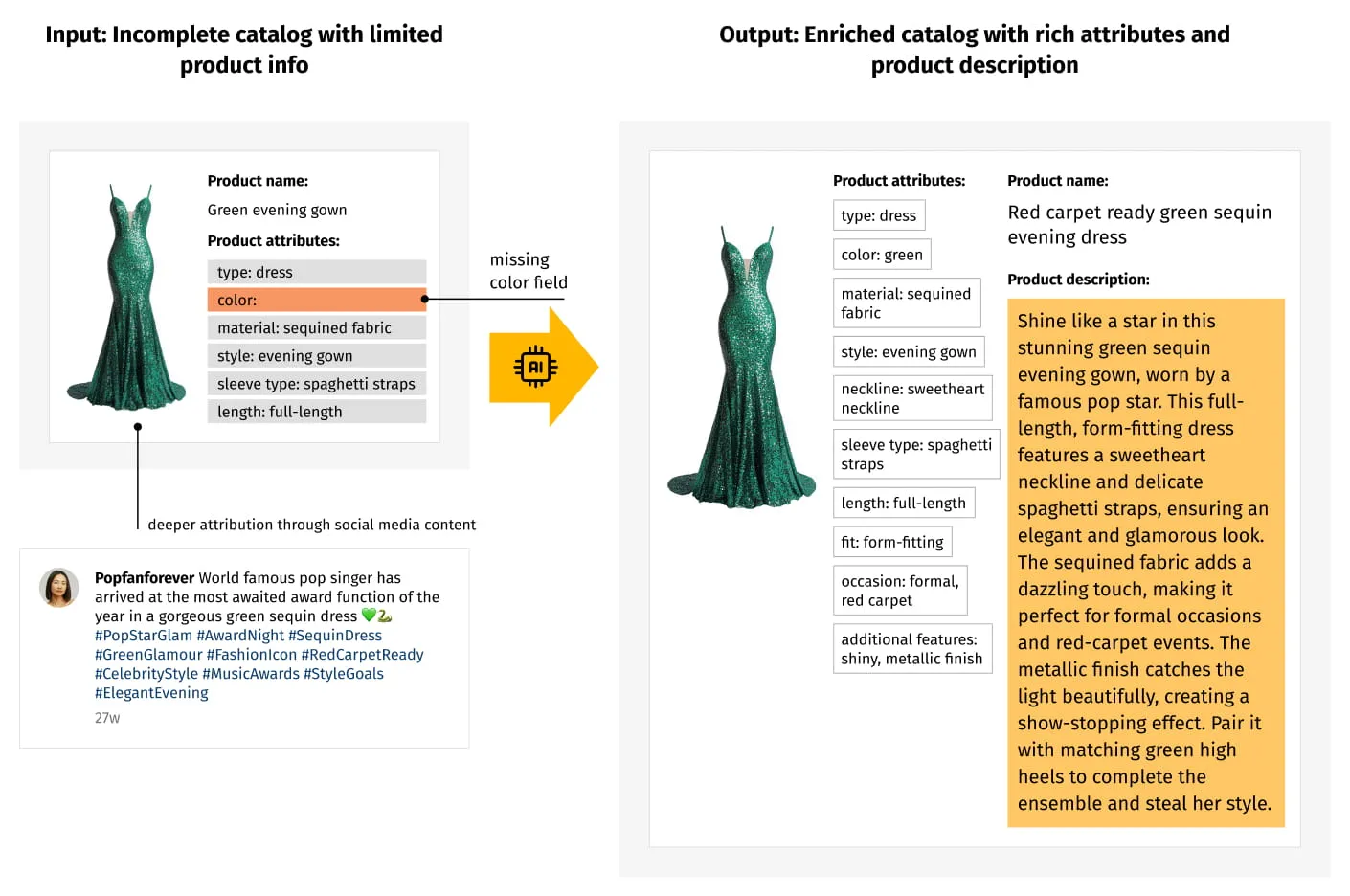
- Visual attribution: Gemini’s multimodal capabilities allow the system to extract precise product attributes directly from images, PDFs, manuals, and other documents—not just structured feeds. Materials, dimensions, components, and features, often missing or inconsistent in supplier data, are identified automatically, closing critical gaps without manual intervention.
- Data harmonization: Units, specifications, and measurements are standardized across vendors and categories. Inches, centimeters, weights, capacities, and formats are normalized so products become truly comparable instead of fragmented.
- Categorization and taxonomy alignment: Using both visual and textual signals, products are continuously mapped to the correct categories and schemas, even as assortments evolve. This keeps category browse, faceted navigation, and search relevance stable over time.
- Creative titles and descriptions: Grounded in structured product data and enriched multimodal signals, Gemini generates accurate, brand-aware titles and descriptions at scale. Content is engaging and consistent, based on real attributes—not generic filler text.
- Personalization: Titles and descriptions can be tailored by customer segment, channel, or region without duplicating or fragmenting catalog data. Multimodal understanding makes personalization richer and more precise.
- User-generated content insights: Gemini analyzes user reviews and social content alongside product data to surface meaningful insights, highlighting real-world benefits, common questions, and usage patterns that enrich PDPs and build confidence.
All of this intelligence feeds directly into the digital storefront:
- Search becomes more relevant and intent-aware
- Facets and filters work reliably
- Recommendations improve because products are truly comparable
- Marketing and SEO benefit from consistent, structured, multimodal product data
- Marketplace listings are created faster and more accurately

The real value unlocked by modern product catalog optimization
Grid Dynamics’ GenAI Content and Catalog Enrichment Starter Kit has helped organizations across industries remove the manual burden that traditionally slows catalog teams while delivering measurable improvements in discovery, conversion, and operational efficiency. Our experts tailor the starter kit to address the unique catalog challenges that arise across different industries and product types.
80% jump in PDP completeness for a leading grocery retailer
A leading grocery retailer manages a massive, fast-changing catalog spanning thousands of suppliers and product categories. As the assortment grew, manual product content creation became a bottleneck. Product detail pages (PDPs) varied widely in quality, and in some categories, features and benefits completeness fell as low as 1%, limiting discovery, engagement, and conversion.
By applying AI-driven catalog enrichment powered by Gemini on Google Cloud, the retailer automated PDP creation at scale. The results were immediate:
- PDP completeness increased from under 1% to over 80%
- Time-to-market for new products dropped significantly
- Manual merchandising effort was dramatically reduced
- Search, navigation, and recommendations became more consistent across the storefront
15X revenue lift in the automotive aftermarket through fitment accuracy
In the automotive aftermarket, catalog accuracy directly determines trust. Customers want a single, definitive answer: Will this part fit my vehicle? In this case, product data was fragmented across ACES/PIES files, interchange datasets, PDFs, images, and legacy systems, making consistent fitment enforcement difficult. AI-powered search combined with GenAI-driven catalog optimization addressed these gaps by:
- Extracting and normalizing data with multimodal GenAI, reading manuals, images, and PDFs to standardize specifications, attributes, and OEM information
- Parsing complex tire specifications (for example, 180/55 R17) and cross-referencing them with vehicle data to prevent dead ends
- Enabling implicit fitment recognition, where queries like “2008 Chevrolet Spark spark plug” automatically apply structured fitment filters
- Modeling fitment as first-class data, indexed at both parent (product) and child (compatibility) levels, supporting more than 100,000 vehicle combinations per SKU
The business impact was clear:
- 6–12% increase in click-through rate (CTR): Clearer fitment signals and more precise listings increased engagement
- 2–7% uplift in conversion rate (CVR): Accurate compatibility indicators and cleaner PDPs reduced hesitation while maintaining recall
- 3–6% growth in revenue per visit (RPV): Better discovery and validated interchange recommendations drove higher-value baskets
- Up to 15× ROI: Revenue lift relative to cost, driven by higher conversion, fewer returns, and reduced manual merchandising effort
Ready to give your catalog a makeover?
An optimized product catalog can unlock a plethora of opportunities for your business. It becomes the foundation for how search performs, how AI reasons, how marketing scales, and how confidently customers buy. When the catalog can’t keep up, every downstream experience suffers.
Grid Dynamics’ GenAI Content and Catalog Enrichment Starter Kit for Google Cloud can help your team optimize catalogs using multimodal AI to automate enrichment, improve accuracy, and accelerate onboarding without adding manual burden. Get in touch to see how it works for your catalog.
Interested in this topic?
Authors
You might also like