






Predictive analytics is undergoing a major transformation. This AI demand forecasting model comparison reveals significant performance gaps between traditional and modern approaches. Demand forecasting has long guided decisions in retail and manufacturing, but today’s data volumes and volatility are exposing the limits of traditional methods. A new AI demand forecasting approach is emerging to meet this challenge: Time Series Foundation Models (TSFMs). These large scale AI models leverage knowledge learned from vast datasets to deliver far superior forecasting accuracy than was previously possible.
In this article, we move beyond theory and present findings grounded in Grid Dynamics’ AI demand forecasting model comparison research. Building on our prior explorations of retail demand forecasting, we introduce the next generation of forecasting solutions powered by TSFMs. In our research, we addressed the following questions:
- What TSFMs are and how their architectures differ from those of earlier generation models (e.g. using Transformers or MLP-Mixers instead of traditional statistical models).
- How leading TSFMs perform in practice. We compare foundation models from Google, Amazon, and IBM against classical baselines on forecasting tasks.
Introduction: The evolving landscape of AI demand forecasting
Time Series Foundation Models are a major step forward in how we approach time-dependent data. They bring the “large model” paradigm, already revolutionary in NLP and CV to the world of time series analysis. In essence, a TSFM is a very large model (often hundreds of millions of parameters or more) that has been pre-trained on massive, diverse time series datasets.
During this extensive pre-training, the model is exposed to a wide variety of temporal patterns, trends, seasonalities, and complex interdependencies across many domains. As a result, it learns a comprehensive array of behaviors inherent to time series data. The model can then apply this broad knowledge to specific forecasting tasks, giving TSFMs an edge even when data is limited or patterns are highly complex. (for more comprehensive overviews of these models and their architectures, see papers in References)
The appearance of foundation models for time series unlocks several capabilities that promise to transform forecasting practice:
- Enhanced accuracy through broad knowledge: because TSFMs learn from extremely large and varied datasets, they can capture complex non-linear patterns and long-range dependencies better than models trained on limited task-specific data. Many TSFMs (often built on Transformer architectures) demonstrate significantly higher accuracy, leveraging their generalized knowledge to make more precise predictions.
- “Cold start” forecasting via zero-shot learning: TSFMs directly address the persistent “cold start” problem. A pre-trained TSFM can produce a reasonable forecast for a brand-new product or scenario with almost no historical data, without needing retraining. In other words, the model can be applied to an unseen time series and still yield useful predictions. With minimal fine-tuning on a small amount of data (few-shot learning), its performance can further improve, effectively solving cold-start challenges that stymie traditional approaches.
- Handling complexity and external factors: these models excel at incorporating external signals (exogenous variables) and handling complex data relationships. A TSFM can ingest not just the target time series but also related inputs like promotions, weather, or economic indicators. It learns how these factors influence demand in non-linear ways, leading to more robust and context-aware forecasts. For example, a foundation model can better isolate the lift from a marketing promotion by recognizing patterns learned from similar events in its vast training data.
- Scalability for big data: TSFMs are designed to scale with modern data volumes. They can train on and forecast across thousands or even millions of time series (e.g., Internet of Things (IoT) sensor networks or expansive retail product catalogs) without sacrificing performance. Thanks to efficient architectures, they handle long sequences and high-frequency data, enabling tasks like large-scale anomaly detection and long-horizon forecasting that overwhelm traditional models.

AI demand forecasting model comparison: Review of leading time series foundation models
The TSFM ecosystem is expanding rapidly, with major technology providers and research labs contributing new models. Below, we highlight some of the most prominent foundation models (which we also evaluated in our research):
- Google TimesFM: [2310.10688] Architecture: Decoder-only Transformer. Scale: ~500 million parameters in version 2.0. TimesFM was pre-trained on a corpus (on the order of 100 billion time points) drawn from diverse sources like Google Trends and Wikipedia page views. Notably, it handles long sequences (up to 2048 time steps) using a patching technique and does not use traditional positional embeddings. TimesFM has shown excellent zero-shot forecasting performance on datasets it never saw during training, often matching or outperforming dedicated models that were explicitly trained on those specific datasets.
- Amazon Chronos: [2403.07815] Approach: “Learning the language of time series.” It (part of the AutoGluon library, e.g., the Chronos-Bolt model) treats time series data like text. It tokenizes numerical time series values into a discrete vocabulary, then uses a Transformer-based sequence model (inspired by large language models such as T5) to predict future tokens (values). Chronos is pre-trained on a collection of public time series data (augmented with synthetic data) and demonstrates strong zero-shot results across many benchmark datasets, effectively generalizing to new series without retraining.
- IBM TTMs (TinyTimeMixers): [2401.03955] Architecture: MLP-Mixer. IBM designed its TinyTimeMixers (e.g. TTM-R2) to be lightweight and fast. They forego Transformers in favor of an MLP-Mixer architecture that mixes information across time steps and features using simple multi-layer perceptrons. This results in a much smaller model footprint and faster computation. Despite their tiny size, TTMs can achieve competitive accuracy, especially when fine-tuned on a specific dataset.
- Salesforce Moirai: [2410.10469] Architecture: Transformer with Mixture-of-Experts. It is intended as a universal AI demand forecasting model capable of zero-shot predictions across a wide range of domains, frequencies, and variables. To handle different types of time series, Moirai uses innovations like multiple patch-size projection layers and an “Any-variate” attention mechanism that can flexibly attend to various input dimensions. The latest version, Moirai-MoE, incorporates a sparse Mixture-of-Experts to scale up capacity (into the billions of parameters) while keeping inference efficient (only a subset of experts activate per input). Moirai was pre-trained on the LOTSA dataset (a large archive of 27 billion time series observations from numerous domains).
- Prior Labs TabPFN-TS: [2501.02945] Approach: Adapting a tabular model to time series. TabPFN-TS originates from a foundation model designed for tabular data (TabPFN v2). Through some feature engineering, the Prior Labs team applied it to time series tasks. Remarkably, even though TabPFN-TS was only pre-trained on synthetic tabular data, it delivered surprisingly strong zero-shot forecasts on standard time series benchmarks.
- Time-MoE: [2409.16040] Architecture: Transformer with Mixture-of-Experts. Time-MoE is a research model that pushes TSFMs to billions of parameters using a sparse Mixture-of-Experts design. It can scale up to, for example, 2.4 billion parameters by having many expert sub-models, where only a few are used for any given forecast. This strategy allows the model to be extremely large but still efficient at inference time. Researchers pre-trained Time-MoE on an extraordinarily large dataset called Time-300B (300 billion time points spanning nine domains).
In addition to the models above, new foundation models for time series are appearing rapidly. For example:
- Datadog Toto: a model tailored to observability time series (such as IT infrastructure metrics and logs). Toto’s training data mixes real-world observability signals with open datasets and synthetic data. It is designed for tasks like multivariate anomaly detection in IT systems.
- YingLong: an AI demand forecasting model focused on high-resolution weather prediction (a limited-area model for meteorology). YingLong demonstrates that foundation model principles can be applied even in specialized domains like weather forecasting.
- TiREX: a model that leverages an extended LSTM architecture to improve in-context learning for time series. TiREX achieves strong zero-shot forecasting performance across both long-horizon and short-horizon scenarios by combining recurrent network ideas with large model training.
- Sundial: a family of models introducing a novel “TimeFlow Loss” to train Transformers directly on continuous time-series values (without needing to discretize or tokenize the data). Sundial models were pre-trained on a “TimeBench” dataset (on the order of one trillion time points).
| Model | Provider | Architecture | Key strength/ focus | Pre- training data | Notes, key points |
| Google TimesFM (v2.0 500M) | Decoder- only Transformer Patch- based, No positional embeddings | Strong zero-shot performance, handles long sequences (2048 points), univariate focus, experimental quantile heads. Experimental covariates | LOTSA pretraining data (TimesFM 2.0); Original TimesFM: 100B real- world points | Excellent zero-shot performer, achieving top results on several datasets | |
| Amazon Chronos-Bolt (Base) | Amazon (via AutoGluon) | Converts time series values into a discrete vocabulary architecture, like the T5 Transformer Language Model | “Learning language of time series,” zero-shot capability | Large public & synthetic corpus (Chronos general) | Top performer on the daily Hierarchical Sales dataset; strong overall results |
| IBM TTM-R2 (Fine-tuned) | IBM Granite | MLP- Mixer | Lightweight, efficient, strong few-shot/ fine-tuned performance | Monash Time Series Forecasting Repository, 700 million samples | Showed the most significant improvement with fine- tuning |
| Salesforce Moirai-1.0- R-Large | Salesforce | Transformer with Any- variate Attention & Multiple Patch Sizes | Universal forecasting, handles varying frequencies/ dimensions, zero-shot | LOTSA dataset (27B observations for Moirai general) | Universal, zero-shot model |
| Prior Labs TabPFN- TS | Prior Labs | Tabular Foundation Model (Transformer- based) | Strong zero-shot via feature engineering, pre-trained on synthetic tabular data | Synthetic tabular data (TabPFN general) | Consistently outperformed baseline; demonstrates the strength of tabular models on TS tasks |
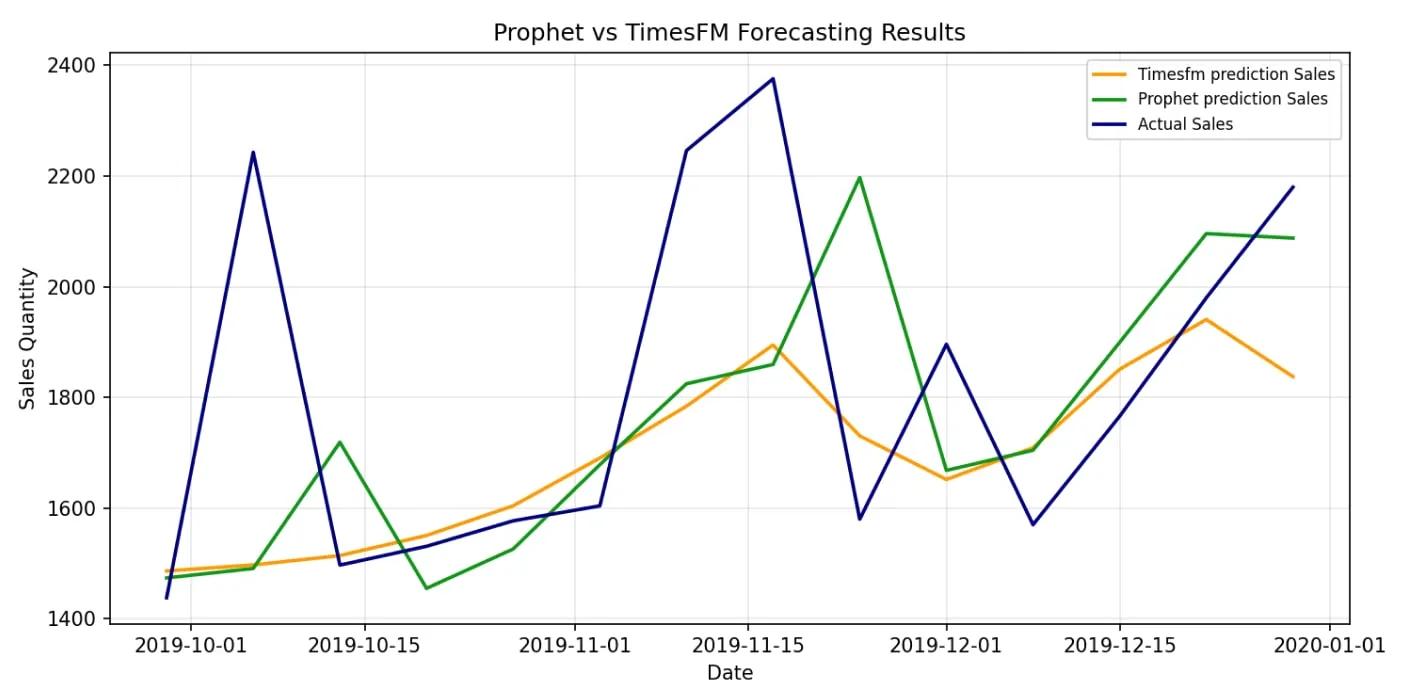
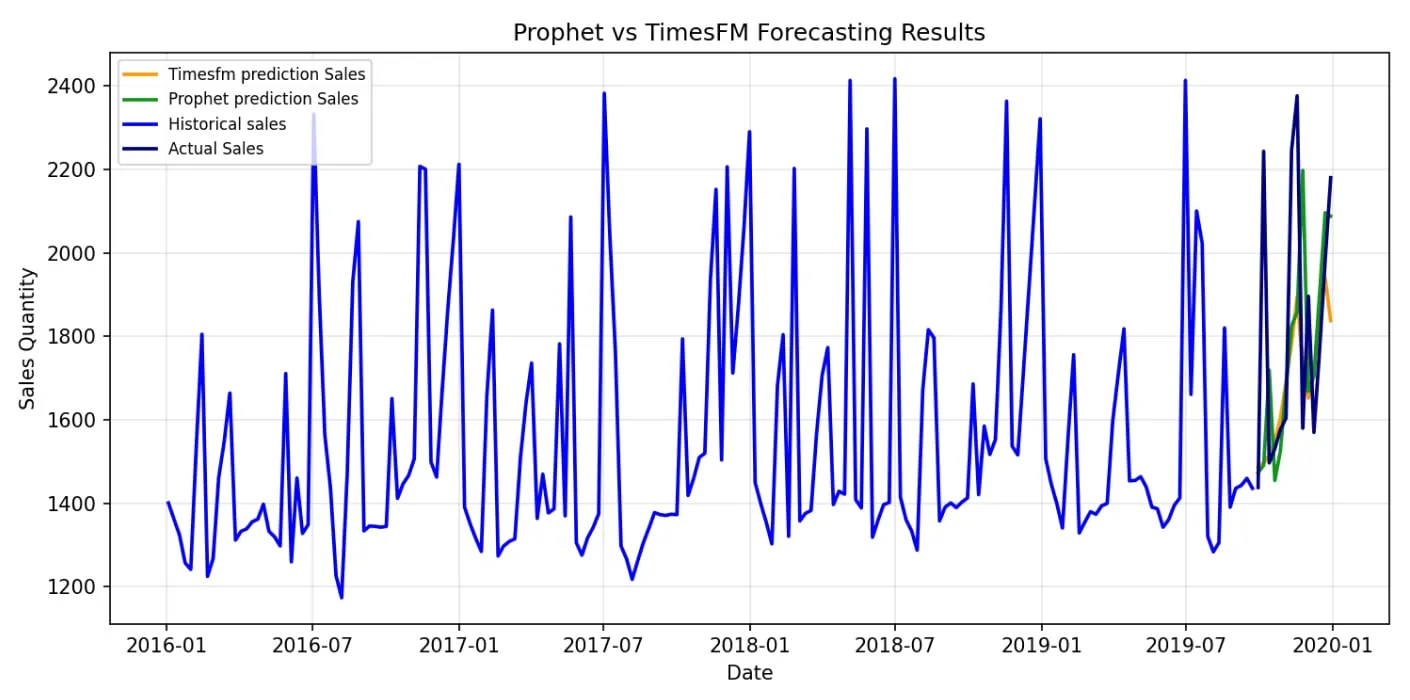
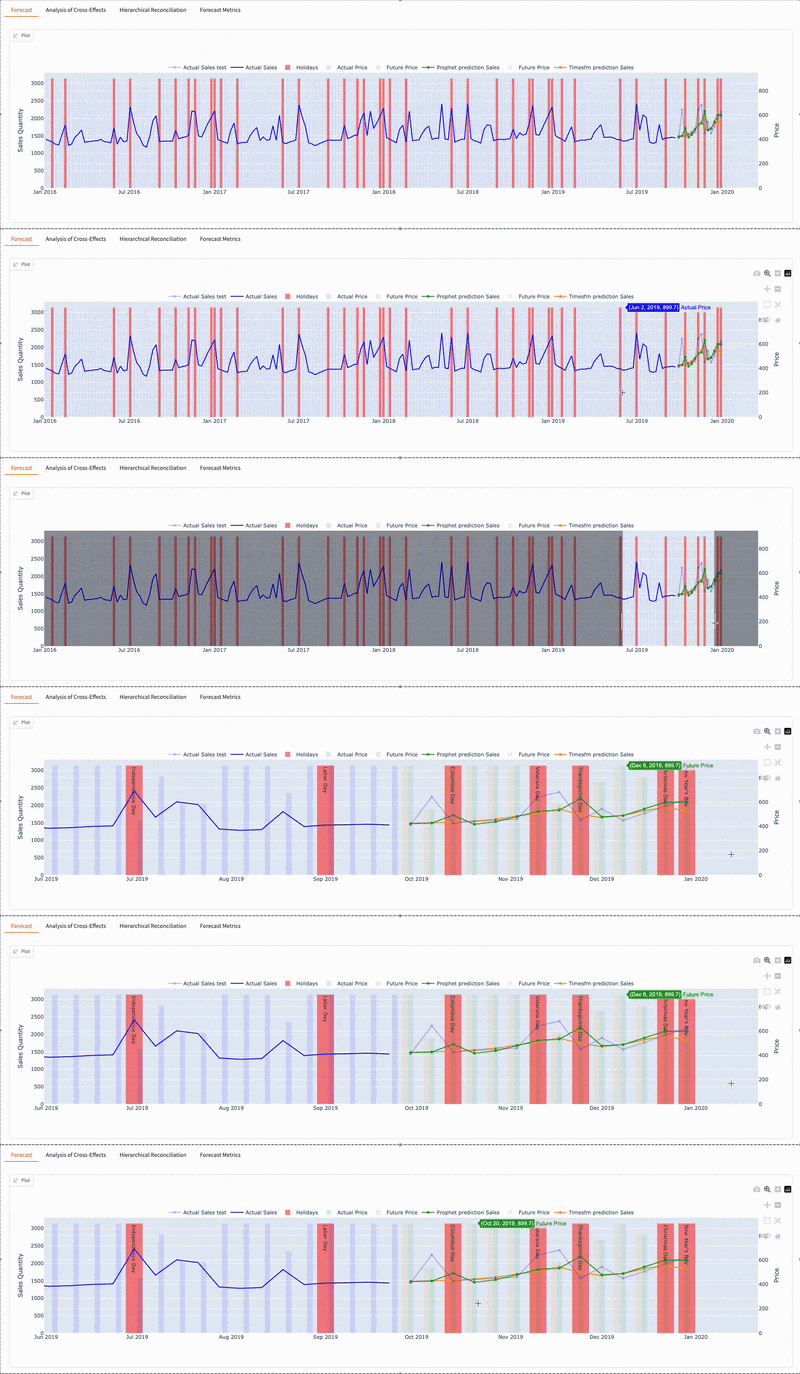
Evaluation of TSFMs
To move from promising theory to proven results, we conducted empirical AI demand forecasting model comparison evaluations of these cutting-edge models. Our goal was to see how well TSFMs actually improve AI demand forecasting in practice, compared to traditional approaches.
Methodology
We benchmarked several foundation models against established forecasting methods to quantify the improvement in our AI demand forecasting model comparison:
- Baselines: as classic benchmarks, we used an Auto ARIMA (Auto-Regressive Integrated Moving Average) model and Facebook Prophet (which we previously deployed in our solutions) to represent traditional forecasting techniques.
- Benchmark datasets:
- To test the models in representative scenarios, we selected a variety of public datasets with different characteristics, including ‘Car Parts demand’ (monthly sales), ‘Hierarchical Sales’ (daily and weekly retail data), and ‘Restaurant’ (daily visitor numbers). To ensure our findings are directly applicable to real-world business challenges, we are also benchmarking the models using our own in-house demand and sales data.
- Datasets: We evaluated performance on a variety of public datasets with different characteristics; for example, car parts demand (monthly sales data), a hierarchical retail sales dataset (which has daily store-level data and weekly aggregated data), and a restaurant visitors dataset (daily customer counts). These cover diverse domains and frequencies. We also included some of our in-house demand and sales data to ensure the findings translate directly to real business scenarios in retail and manufacturing.
- Standard evaluation metrics:
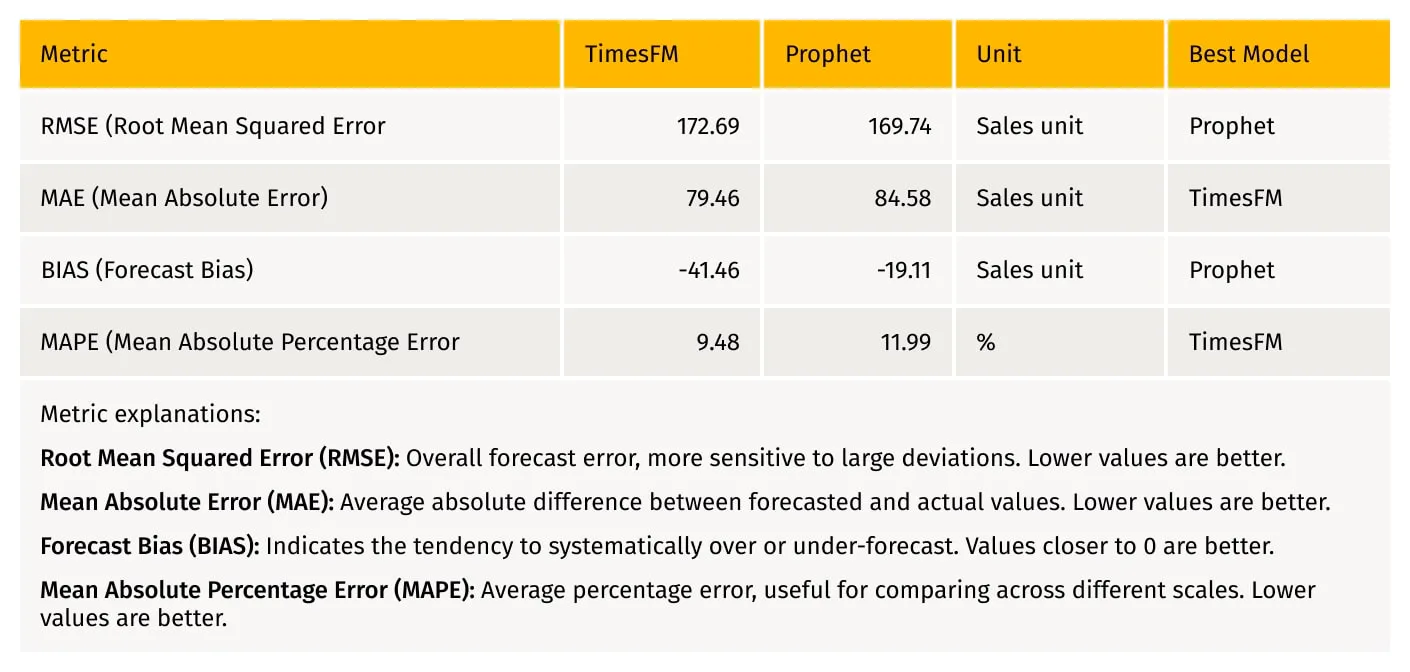
- Mean Absolute Error (MAE), Mean Absolute Percentage Error (MAPE), and Root Mean Squared Error (RMSE), Forecasting Bias.
- Evaluation metrics: We used standard error metrics to assess accuracy. Mean Absolute Error (MAE), Root Mean Squared Error (RMSE), Mean Absolute Percentage Error (MAPE), and Mean Absolute Scaled Error (MASE). We also examined probabilistic forecast metrics: the Pinball loss (quantile loss) for specific forecast quantiles and the Continuous Ranked Probability Score (CRPS) for overall predictive distributions. Using multiple metrics gives a comprehensive view of performance, capturing both average error and how well models quantify uncertainty.
For clarity, here is a brief recap of these metrics:
- MAE (Mean Absolute Error): the average of absolute errors between forecasted and actual values. MAE is easy to interpret (in the same units as the data) and gives a straightforward measure of typical error magnitude.
- RMSE (Root Mean Squared Error): the square root of the average squared error. RMSE penalizes large errors more heavily than MAE, which is useful when big mistakes are especially undesirable.
- MAPE (Mean Absolute Percentage Error): the average absolute error expressed as a percentage of actual values. MAPE is scale-independent, allowing comparison across datasets (though it can be sensitive if actual values approach zero).
- MASE (Mean Absolute Scaled Error): the error scaled relative to a naive baseline method (typically the seasonal naive forecast). A MASE < 1 indicates the model outperforms the naive baseline. This metric is robust and useful, especially for intermittent demand series.
- Pinball Loss (Quantile Loss): evaluates the accuracy of probabilistic forecasts at a given quantile (e.g., 90th percentile forecast). It asymmetrically penalizes over- vs. under-prediction, effectively checking if the predicted quantiles are well-calibrated against actual outcomes.
- CRPS (Continuous Ranked Probability Score): a metric that generalizes MAE to probabilistic forecasts. CRPS considers the entire predicted distribution for each time point, rewarding forecasts that assign more probability mass near the true value (i.e., that are sharp and well-calibrated).

Key findings
The results of our AI demand forecasting model comparison benchmarks confirm the improvements of foundation models in comparison to classical time series models. In every dataset we tested, a TSFM delivered more accurate forecasts than the traditional Auto ARIMA baseline. For instance, on a monthly car parts sales dataset, one of the TSFMs reduced MAE by over 15% compared to ARIMA; on a daily restaurant visitors dataset, the improvement was about 25%. Across the board, the foundation models significantly outperformed classical forecasting in terms of error reduction.
| Dataset | Metric | Auto ARIMA (Baseline) | TimesFM | Chronos-Bolt | TTM-R2 (fine-tuned) | TabPFN-TS |
| Car Parts (Monthly) | MAE | 0.53 | 0.522 | 0.48 | 0.442 | 0.465 |
| Hierarchical Sales (Daily) | MAE | 2.5 | 2.321 | 2.308 | 2.341 | 2.38 |
| Hierarchical Sales (Weekly) | MAE | 11.2 | 8.621 | 9.084 | 9.001 | 8.974 |
| Restaurant (Daily) | MAE | 9.99 | 7.242 | 7.329 | 7.325 | 8.295 |

Models such as IBM’s fine-tuned TTM-R2, Google’s TimesFM, Amazon’s Chronos-Bolt, and Prior Labs’ TabPFN-TS all showed higher performance, often neck-and-neck with each other, while handily improving in comparison to the classical time series methods. The exact leaderboard varied by dataset. For example, Amazon’s Chronos slightly edged out others on one daily sales dataset, whereas Google’s TimesFM led on a weekly sales dataset, but the overarching pattern is clear. Foundation models consistently provide a leap in accuracy over traditional forecasting.
Real-world impact: Use cases transformed by TSFMs
The advanced capabilities of TSFMs are not just academic—they directly translate into better results in key demand forecasting use cases for retail and manufacturing (among other domains). Many core business processes in these industries rely on accurate demand forecasts, from financial planning and inventory management to staffing and supply chain logistics. By improving forecast accuracy and flexibility, TSFMs enable improvements across all these areas. They also open the door to new applications that were hard to tackle before.
Here are a few high-impact use cases that TSFMs enhance:
- New product demand forecasting (“cold start”): Predicting demand for a new product with no sales history is notoriously difficult (the classic cold start problem). Traditional forecasting methods typically fail here because there is no historical data to extrapolate. TSFMs, however, offer a data-driven solution: a pre-trained TSFM can draw on patterns learned from thousands of other products to generate an initial forecast for the new item. In practice, we’ve found that a zero-shot TSFM can provide surprisingly reasonable forecasts for a product launch, making educated guesses based on similar items and general trends. This capability fundamentally changes how retailers plan for new product introductions, eliminating much of the guesswork.
- Promotional and event uplift forecasting: Sudden spikes or dips in demand due to promotions, holidays, or special events are challenging to forecast. These effects are highly non-linear and often depend on external drivers (marketing spend, competitor actions, etc.). TSFMs shine in this scenario by incorporating exogenous variables and complex interactions. They can learn from many examples of past promotions (across different products or even different companies) to estimate the uplift more accurately. The result is more reliable baseline forecasts and a clearer attribution of how much a promotion changed demand. For retailers, this means better planning around promotional events and clearer findings into promotion effectiveness.
- Short-term demand sensing: In fast-moving markets, businesses need to react quickly to the latest data (e.g., last week’s spike in sales or yesterday’s drop in web traffic). Traditional models often require retraining or manual adjustment to “sense” these short-term changes. TSFMs, by contrast, can absorb large volumes of real-time data and adapt on the fly. Because they’re built to handle massive data streams, they can continuously ingest new information (from point-of-sale (POS) systems, social media trends, etc.) and update forecasts accordingly. This leads to more agile and responsive demand sensing; for example, detecting a sudden change in demand and adjusting inventory deployment within days or hours instead of weeks.
- Inventory and supply chain optimization: Ultimately, better forecasts lead to a more efficient supply chain. By reducing forecast error, TSFMs help companies avoid overstocking (which ties up capital in inventory) and understocking (which causes lost sales and customer dissatisfaction). For instance, if a TSFM improves weekly forecast accuracy significantly, a retailer can lower safety stock levels without increasing stockout risk. Over time, the cost savings from reduced inventory carrying costs and the revenue gains from higher in-stock availability can be substantial. Additionally, TSFMs can provide more accurate long-range forecasts by picking up on external trends, which aids in strategic planning (e.g., capacity planning for manufacturing or long-term supplier contracts). The result is a supply chain that’s not only leaner but also more resilient to demand volatility.

The architecture driving TSFMs
Why do TSFMs represent such a leap forward? Three key pillars make these models fundamentally different from earlier time-series approaches:
- Advanced model architectures
- Massive and diverse training data
- Novel learning strategies
Together, these enable the performance and flexibility we’ve described.
- Transformer foundations: Many state-of-the-art TSFMs, such as Google’s TimesFM and Salesforce’s Moirai, use the Transformer architecture. Transformers use a self-attention mechanism to weigh the importance of different time points in the series, which is extremely effective for capturing long-range dependencies. For example, a Transformer-based TSFM can learn that a sales dip today might relate to a promotion that ran six months ago, something that shorter-context models would miss. These models also use techniques like patching (breaking a long time series into shorter segments or “patches” for processing) to handle very long sequences efficiently. The bottom line is that Transformers give TSFMs a powerful way to model complex temporal relationships over extended periods.
- Alternate architectures (MLP-Mixers): Transformers aren’t the only option. IBM’s TinyTimeMixers show that simpler architectures can also be effective. TTMs use an MLP-Mixer architecture, which basically means they alternate between mixing information across the time dimension and across features using simple feed-forward layers (MLPs). This architecture is computationally lighter and faster to train. The trade-off is potentially less cost than Transformers, but for many forecasting tasks, TTMs prove sufficiently capable, and their speed and small size make them attractive when resources are limited or quick deployment is needed.
- Language-model style adaptation: Another approach is to treat time series data like language data. Amazon’s Chronos, for instance, converts continuous time series into a sequence of “tokens” and then trains a model to predict the next token, akin to how a language model predicts the next word. This leverages all the advancements in NLP (like powerful sequence transformers) for forecasting. It’s a creative re-imagining of AI demand forecasting: instead of predicting a number directly, the model predicts a token that represents that number. This method brings the robustness of language models (like handling varying input lengths and contexts) into time series, and Chronos’ performance suggests it’s a promising direction.
- Mixture-of-Experts (MoE) for scale: To scale models to even larger sizes, some TSFMs use a Mixture-of-Experts architecture. MoE models (like Salesforce’s Moirai-MoE and the research prototype Time-MoE) consist of multiple expert subnetworks, each specialized in certain patterns. A gating mechanism then routes each input to the most relevant expert(s). This way, not all parts of the model are active for every forecast; only a small subset of experts are, making it feasible to have a model with billions of parameters without proportionally increasing computation. MoEs enable TSFMs to achieve very high capacity (capturing many different types of time series behaviors) while still scaling efficiently during inference.
The fuel: large-scale, diverse pre-training datasets
A critical factor in TSFMs’ success is the scale and diversity of their training data. These are foundation models because they build a broad foundation of knowledge by training on countless time series from many domains. For example, the LOTSA (Large-scale Open Time Series Archive) dataset spans nine domains and includes over 27 billion individual time-point observations, giving a TSFM exposure to everything from retail sales and finance to climate data. Similarly, the open Monash Time Series Forecasting Archive compiles dozens of varied time series datasets for researchers, and TSFMs often leverage such collections. At the extreme end, the Time-MoE model we discussed was trained on a proprietary Time-300B dataset: an astonishing 300 billion data points. This breadth and depth of training data means a TSFM isn’t just an expert on one company’s sales history; it has seen patterns from around the world and across industries. This is why it can generalize and adapt so well: it has learned the “universal” characteristics of time series data in a way no small-scale model could.
Conclusion
Foundation models for time series forecasting are poised to redefine what’s possible in demand planning. Our AI demand forecasting model comparison demonstrates the shift from small, task-specific models to large, pre-trained TSFMs is as significant for AI demand forecasting as the advent of deep learning was a decade ago—it marks a new era of accuracy and capability. Our research and evaluation underscore several key advantages of TSFMs:
The key advantages of TSFMs are compelling and multifaceted. As highlighted and validated by Grid Dynamics’ research initiative, these models offer:
- Improvement in accuracy: By training on massive datasets, TSFMs capture subtle patterns and deliver significantly lower error rates than traditional forecasting approaches. Across multiple tests, they consistently outperformed classical time series models, often by a wide margin.
- Effective cold-start forecasting: Zero-shot learning with TSFMs provides a practical solution for forecasting new products or other cases with little historical data. This was previously an unsolved problem in demand planning, now directly addressed by foundation models.
- Robust handling of complexity: TSFMs incorporate external factors and long-range effects naturally, making forecasts more context-aware. They can simultaneously consider macro-trends, seasonal effects, and recent anomalies, leading to more reliable results under complex conditions.
- Scalability and flexibility: Designed for modern big data environments, TSFMs can handle huge numbers of time series and very long sequences. This scalability makes them suitable for large retailers, manufacturers, or IoT applications that generate enormous amounts of time series data.
In summary, organizations that adopt time-series foundation models can gain a distinct competitive edge through more accurate forecasts and faster findings. Grid Dynamics has been at the forefront of exploring these TSFM technologies. We are ready to help businesses apply them to real-world challenges, from demand forecasting to anomaly detection. If you’re interested in leveraging TSFMs for your business, we invite you to reach out to our experts for a deeper conversation. Contact us today.
References
Surveys:
- [2403.14735] Foundation Models for Time Series Analysis: A Tutorial and Survey
- [2401.13912] A Survey of Deep Learning and Foundation Models for Time Series Forecasting
- [2411.05793] A Comprehensive Survey of Time Series Forecasting: Architectural Diversity and Open Challenges
- [2211.05244] Deep Learning for Time Series Anomaly Detection: A Survey
TSFMs:
- TimesFM: [2310.10688] A decoder-only foundation model for time-series forecasting
- Chronos: [2403.07815] Chronos: Learning the Language of Time Series
- IBM TTMs: [2401.03955] Tiny Time Mixers (TTMs): Fast Pre-trained Models for Enhanced Zero/Few-Shot Forecasting of Multivariate Time Series
- Salesforce Moirai: [2410.10469] Moirai-MoE: Empowering Time Series Foundation Models with Sparse Mixture of Experts
- TabPFN: [2501.02945] From Tables to Time: How TabPFN-v2 Outperforms Specialized Time Series Forecasting Models
Authors
You might also like