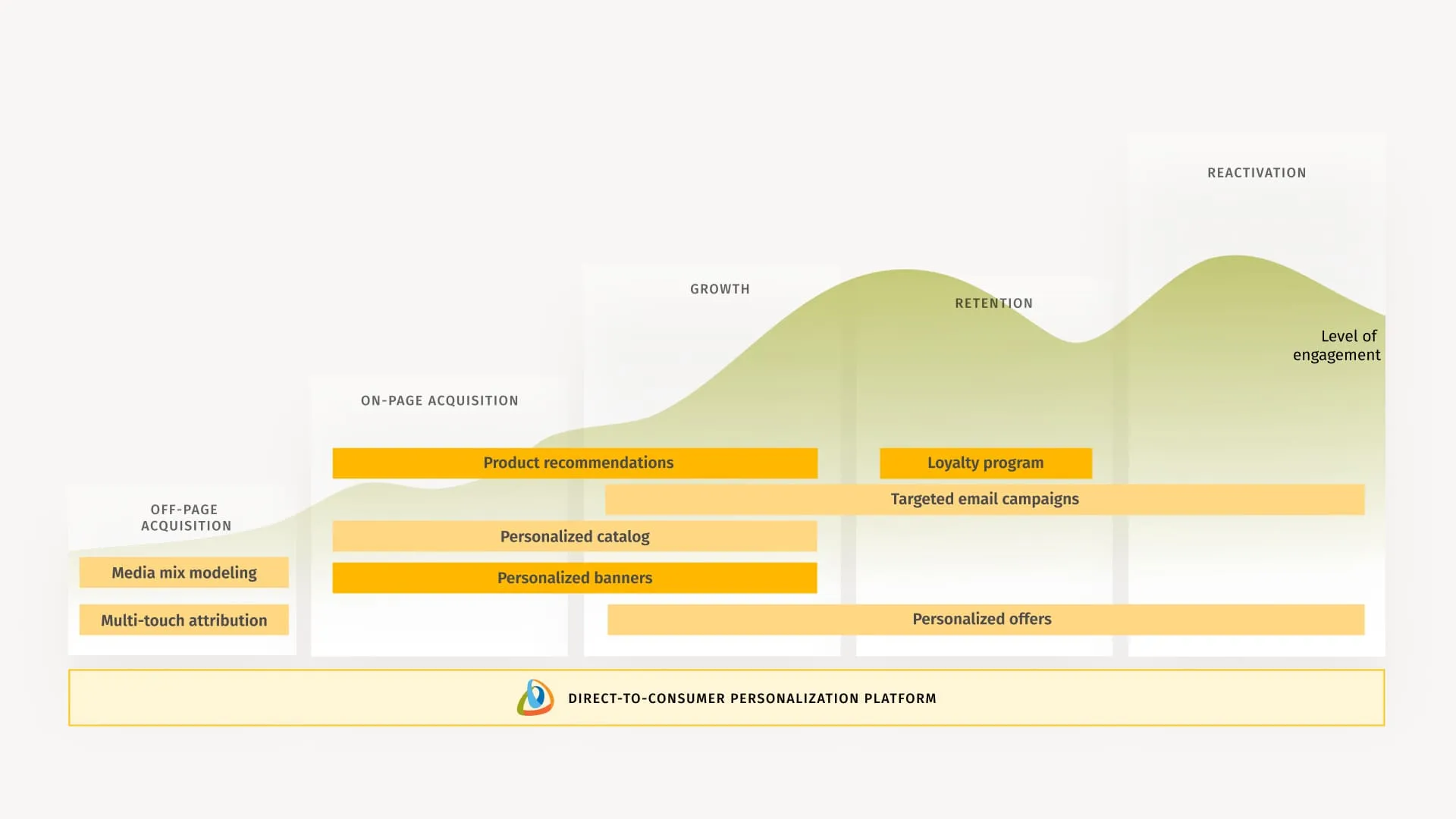



Customer intelligence platform
A customer intelligence platform collects, unifies, and analyzes customer data from diverse sources to generate insights for better decisions. It collects data from CRM systems, e-commerce platforms, mobile apps, contact centers, and external providers to build a comprehensive view of customer behaviors, needs, and preferences.
The platform applies analytics and Artificial Intelligence (AI) to suggest actions such as targeted offers, channel selection, or risk identification, then feeds these into marketing, product, sales, and service systems.
Evolution from customer data to customer intelligence
Customer data systems began as standard repositories that stored transaction details, profiles, and campaign histories, often spread across CRM tools, analytics platforms, and channel-specific databases. Reporting focused on aggregate metrics like opens, clicks, or revenue by campaign, which helped measure performance but gave limited insight into individual customer journeys or future behavior.
Customer intelligence platforms represent the next stage, combining customer 360 data management, advanced scoring models, and a central decision engine that can drive personalized experiences across web, mobile, email, call centers, and paid media from a single intelligence layer.
They use methods such as propensity modeling, lifetime value estimation, sequence-aware deep learning, and reinforcement learning to predict outcomes and optimize which message, product, or action to deliver in each moment.
Its role differs from that of systems such as CDPs, CRMs, and traditional analytics tools. A CDP focuses on collecting and unifying data, while a CRM manages sales and service workflows, and analytics platforms produce dashboards for human interpretation.
A customer intelligence platform sits on top of or alongside these systems to generate intelligence and decisions. It feeds scores, segments, and recommendations back into marketing, experience, and operational tools so intelligence is actually used in day-to-day interactions.
Types of customer data used in customer intelligence platforms
Customer intelligence platforms work only as well as the data they receive. They rely on a wide mix of signals to build a reliable view of each customer and to support accurate predictions. The goal is not just more data, but the right blend of depth, coverage, and quality across channels.
Key data types usually include:
- Profile and demographic data: Basic attributes such as name, contact details, location, age band, household, and account information are typically sourced from CRM systems, loyalty programs, and registration flows. This data anchors identity and helps segment at a high level, for example, by region or customer tier.
- Transactional and lifecycle data: Purchase history, subscriptions, renewals, returns, payments, and product usage events form the backbone of most customer intelligence work. These records show value over time, help estimate lifetime value, and reveal which products or services drive retention or churn.
- Behavioral and digital interaction data: Clickstream events from web and mobile, search queries, content views, email opens, and app engagement give fine-grained insight into intent and journey stage. This type of behavioral data helps models understand what a customer is interested in now, not just what they bought in the past.
- Service and support interactions: Contact center logs, chatbot transcripts, ticket history, and satisfaction scores capture why customers reach out and how issues are resolved. These signals are vital for churn analytics, experience improvement, and “save” offers to at-risk customers.
- Marketing response and campaign data: Impressions, clicks, conversions, suppression, and frequency data from ad platforms and marketing automation systems show how customers react to messages across channels. This feedback loop trains predictive models that foresee demand and recommend which offer, channel, or timing is most likely to work next.
- Third-party and enrichment data: External datasets, such as credit risk scores, firmographic attributes, interests, and location-based signals, provide context that first-party systems do not capture. Enrichment is essential in B2B and financial use cases where risk and compliance are paramount.
- Unstructured data from text and media: Reviews, social posts, survey comments, support notes, and even call transcripts contain rich sentiment and intent signals that do not fit into traditional tables. Modern platforms use Natural language processing (NLP) and LLM models to extract topics, sentiment, and entities, so this information can feed segmentation, churn models, and product decisions.
Strong customer intelligence platforms invest heavily in data quality, identity resolution, and AI governance on top of these data types, so that models and decisions are based on accurate, timely information and not noisy, duplicate records.
Core intelligence capabilities
Customer intelligence platforms focus on turning raw data into actionable decisions. They do this through a set of core intelligence capabilities that work together across the customer lifecycle.
Segmentation and customer scoring
Platforms group customers into segments based on behavior, value, needs, or risk, from broad clusters down to microsegments that reveal hidden patterns. These segments drive targeted campaigns, tailored journeys, and pricing or product strategies that match how different groups actually behave.
Advanced scoring adds another layer by assigning each customer a score for likelihood to churn, predicted lifetime value, interest in a product category, or channel responsiveness. This scoring helps teams prioritize where to invest marketing, service, and sales efforts, rather than treating every customer the same.
Propensity modeling and prediction
Propensity models estimate how likely a customer is to buy, renew, upgrade, or leave given their current behavior and history. Time-based models go further by estimating when a customer is likely to need replenishment or when churn risk will rise, enabling proactive outreach before problems surface. These predictions transform customer intelligence from backward-looking reporting into forward-looking guidance.
Next-best-action and decision engines
Decision engines use scores and business rules to recommend next steps for each customer: send an offer, escalate to a human, adjust a price, or hold back. Strong platforms apply this logic consistently across channels, so a website, mobile app, call center, and marketing system all draw from the same decision framework instead of making disconnected choices. This creates a coherent customer experience where each interaction builds on what came before.
Journey and experience analytics
Event and journey analysis shows which paths lead to conversion or satisfaction and which steps cause drop off or complaints. These insights support experience design decisions, from simplifying checkout flows to redesigning onboarding for digital products. Understanding the full journey reveals where friction exists and where moments of delight can shift customer perception.
Measurement and feedback loops
Customer intelligence platforms track how well their own recommendations perform by measuring lift, response, and long-term impact. They feed those results back to improve future decisions, turning a static scoring setup into a learning system that adapts as customer behavior shifts.
Role of AI and advanced analytics
Artificial intelligence (AI) is what turns a customer intelligence platform from a reporting tool into an automated system that learns and improves over time. Machine learning models handle most of the heavy lifting behind scoring, prediction, and next-best-action, but in practice, this goes beyond a single model per use case. Mature platforms rely on whole model families:
- deep learning models for advanced customer intelligence that can work with clickstream, text, and image signals together;
- sequence models that understand customer journeys;
- reinforcement learning tests different action sequences to see which paths maximize long-term value.
Large language models add another layer by making unstructured feedback usable. They read reviews, survey comments, focus group transcripts, and social posts, then surface themes, sentiment, and unmet needs that do not show up in structured data. This powers use cases like AI focus groups, where virtual personas built from real customer content can react to new product ideas, offers, or messages before they go to market.
Behind the scenes, data and ML platforms keep all of this reliable. Experiment tracking, feature stores, model versioning, and automated deployment pipelines enable moving from notebook prototypes to production decision engines without months of rework.
MLOps and LLMOps practices handle monitoring, drift detection, and retraining so churn models, recommendation engines, and language models stay accurate as behavior, products, and channels change. The result is an AI-powered customer intelligence platform that manages a portfolio of models to ensure they remain healthy and usable in day-to-day operations.
What makes the best customer intelligence platform
The best customer intelligence platform fit is always tied to what the business wants to achieve. For most enterprises, that starts with a clear set of use cases and then evaluating platforms against a few core capabilities.
High-value enterprise use cases
- Personalization at scale: Retailers, banks, and subscription businesses use customer intelligence to move from broad segments to individualized experiences. Intelligence platforms support audience targeting, preferred product, best communication timing, product recommendations, personalized pricing, and offers based on current intent.
- Churn prevention and retention: Telecom, media, and SaaS providers rely on churn models and early warning signals to spot at-risk customers, combined with targeted retention journeys and save offers triggered at the right moment.
- Experience and journey optimization: Enterprises use journey analytics to identify where customers drop off, then link these insights to experimentation and next-best-action so teams can test new flows and measure which paths improve satisfaction and conversion.
- Cross-sell, upsell, and loyalty: Banks, insurers, and retailers depend on product affinity and lifetime value models to decide which product to show next and how to reward loyal customers with targeted offers.
- Product and proposition decisions: Product teams use customer intelligence solutions to see which features drive engagement and where unmet needs appear in feedback and behavior data, supporting more confident decisions about what to build.
Foundational criteria for evaluating platforms
- Data breadth and quality: Ability to ingest, unify, and clean data from transactional systems, digital channels, service platforms, and external providers with strong identity resolution and support for both structured and unstructured data.
- AI and analytics depth: Support for segmentation, scoring, propensity models, next best action, and journey analytics with room to plug in custom models and features when needed.
- Scale and performance: Ability to handle millions of profiles, high event volumes, and low latency scoring for real-time recommendations during live sessions, not only nightly batches.
- Integration and activation: Easy ways to push segments, scores, and recommendations into marketing platforms, commerce systems, mobile apps, call centers, and warehouses through native connectors and APIs.
- Governance, trust, and control: Built-in controls for privacy, consent, and data residency, plus model monitoring, fairness checks, and clear audit trails for regulated environments.
Activating customer intelligence
Activating a customer intelligence platform means connecting insights to the systems that touch customers daily, turning scores and predictions into personalized experiences across channels.
Implementation phases
Phase | What Happens | Key activities |
Use case definition | Identify 3 to 5 priority business problems to solve. | Define metrics for acquisition, retention, churn prevention, cross-sell, and next-best-action. |
Data foundation | Connect and unify customer data sources. | Integrate CRM, ecommerce, mobile apps, service platforms, and third-party data into a shared customer profile layer. |
Model development | Build scoring and prediction models. | Create propensity scores, lifetime value (LTV) estimates, segmentation, and product affinity models using machine learning. |
Decision logic | Design rules and automation. | Define next-best-action, channel selection, dynamic targeting thresholds, and campaign arbitration logic that combines scores with business constraints. |
Channel activation | Wire intelligence into operational systems. | Push scores, segments, and recommendations into marketing automation, commerce platforms, mobile apps, and call centers through APIs and event streams. |
Measurement and feedback | Track performance and refine. | Compare model-driven decisions against control groups, measure lift and ROI, then retrain models based on results. |
How intelligence flows through the technology stack
Customer data flows from transactional systems into a unified customer profile layer. The data and machine learning platform processes this data to generate advanced signals like churn risk, lifetime value, product affinity, and replenishment cycles.
These signals feed into a decision engine that combines scores with business rules, budgets, and campaign metadata to determine the best product, offer, channel, and timing for each customer. The decisions are activated across channels such as email, web, mobile, display ads, and point-of-sale systems, creating a consistent, personalized experience.
Strong platforms include experimentation and dynamic optimization capabilities that use reinforcement learning, multi-armed bandits, and learning-to-rank algorithms to test and improve decisions in real time continuously. MLOps practices monitor model accuracy, detect drift, and trigger retraining to keep the system reliable as customer behavior and business conditions change.
When implementation, decision logic, and activation work together, a customer intelligence platform becomes an operational engine that marketing, product, and service teams use every day to deliver relevant experiences at scale.