


Digital Twins
A digital twin is a virtual representation of a physical asset, system, or process that mirrors its real-world counterpart through continuous, two-way data synchronization. Unlike static models or one-time simulations, digital twins evolve alongside the actual entity throughout its entire lifecycle: from initial design and deployment through operation, maintenance, and eventual decommissioning. This living connection transforms how organizations monitor performance, predict failures, test changes, and optimize outcomes without risking physical disruption or downtime.
Organizations apply this concept across factory floors, supply chains, warehouses, and even customer experiences by using the virtual model to understand what is happening now and what might happen next. It helps them reduce risk, cut costs, and make faster, more confident decisions.
What separates a digital twin from other digital models?
Three characteristics define a true digital twin:
- Real-time data synchronization: Digital twins consume live data from sensors, IoT devices, and operational systems to continuously reflect current conditions, not just historical snapshots.
- Bidirectional data flow: Unlike a “digital shadow” that only monitors (one-way data flow), a true twin can send information back: control commands, recommended adjustments, or alerts that change how the physical system operates.
- Lifecycle continuity: Digital twins track an asset from concept through retirement. A jet engine’s twin might start as a design prototype, become an instance twin for each manufactured engine, and later aggregate fleet data to inform maintenance schedules and next-generation designs.
Without these three elements working together, you’re working with a simulation, a dashboard, or a model, not a digital twin.
Core components of a digital twin
Digital twins rest on four conceptual building blocks that work together to create a living, actionable representation of the physical world.
The physical entity
This is the real-world object or system being mirrored. It could be a single robotic arm, an entire production line, a warehouse full of inventory, or a complex supply chain network. The entity exists independently and generates data from sensors, operational logs, and performance metrics. Without a clear understanding of what you’re modeling and why, a digital twin becomes a solution looking for a problem.
The virtual model
The virtual model is a digital replica that captures your physical entity’s essential attributes, such as geometry, behavior, constraints, and performance characteristics. It’s built from CAD files, physics simulations, historical data, and process logic that define how the entity should operate under different conditions.
Unlike a static 3D rendering, this model updates dynamically as new data arrives. When a production line changes speed or a shipment moves to a new location, the virtual model reflects that shift. The model’s fidelity determines what questions it can answer, whether it’s monitoring basic health metrics or running complex simulations to test changes before applying them in the real world.
Connection layer
The connection layer is what keeps the physical and virtual sides synchronized. Sometimes called the “digital thread,” this infrastructure moves data bidirectionally between the two worlds.
From physical to virtual, the connection layer handles:
- Data collection through IoT sensors, gateways, and edge devices
- Protocol translation across standards like OPC-UA, MQTT, Modbus, and TCP/IP
- Edge processing for filtering, aggregation, and local analytics before cloud transmission
- Secure, low-latency transmission to cloud platforms or on-premise data centers
From virtual to physical, it delivers:
- Control commands and parameter adjustments based on simulation outcomes
- Alerts and notifications when the model detects anomalies or predicts failures
- Recommended actions from optimization algorithms or agentic AI assistants
This bidirectional flow is what separates a digital twin from a monitoring dashboard. The twin doesn’t just watch but influences what happens next.
Intelligence layer
Data alone doesn’t drive decisions. The intelligence layer applies analytics, machine learning, and Artificial Intelligence (AI) to turn streams of sensor readings and operational events into actionable insight.
This layer operates across four levels of capability:
Capability | What it does | Example application |
Descriptive | Monitors current state and performance | Real-time dashboards showing equipment status, throughput, and utilization rates. |
Diagnostic | Identifies why events occurred | Root cause analysis tracing equipment failures back to specific parameter deviations or process changes |
Predictive | Forecasts future conditions and risks | Anomaly detection flagging equipment degradation before failure, demand forecasting for inventory planning |
Prescriptive | Recommends or automates actions | Agentic AI provides guidance on resolution strategies, optimization algorithms, and adjusting production schedules |
The intelligence layer learns over time. As more data flows through the system, models improve accuracy, adapt to changing conditions, and surface patterns human operators might miss. This adaptive capability is what makes digital twins valuable for continuous improvement, not just one-time analysis.
How do these components work together?
These four elements form a closed feedback loop. The physical entity generates data; the connection layer transmits it to the virtual model; the intelligence layer analyzes patterns and predicts outcomes; and insights flow back through the connection layer to adjust how the physical entity operates.
Types of digital twins
Digital twins are not one-size-fits-all. They vary based on what they represent and how organizations use them. In practice, most enterprises layer several types together, orchestrating how work actually gets done across that landscape.
Product digital twins
Product digital twins represent individual components or complete assets. They track a physical item from design through operation and capture how it behaves in real conditions compared to how it was designed.
- Component twins are the most granular. Think of the digital representation of a single bearing, valve, sensor, or weld seam. These twins focus on local health metrics such as temperature, vibration, wear, or dimensional accuracy. When a component twin shows early signs of degradation, the organization can replace or recalibrate that part before it causes wider issues.
- Asset twins combine multiple components into a single functional unit. A robotic arm, a conveyor line segment, or a packaging machine each can have an asset twin that reflects how its components work together. These twins surface performance patterns that only appear when you look at the assembly as a whole, such as specific load conditions that create vibration, heat, or quality drift.
Product twins help teams validate designs before building physical prototypes, monitor performance in the field, and feed real-world data back into engineering and maintenance decisions.
Process digital twins
Process digital twins model workflows, sequences, and operating rules. Rather than focusing on equipment internals, they describe how work moves across assets, people, and systems over time.
This can cover:
- The sequence of production steps, changeovers, and material flows through a plant
- How multiple robots coordinate tasks in a shared workcell
- How inspection tasks are ordered, where decisions happen, and how results feed back into rework or release
With a process twin, teams can test new scheduling strategies, routing rules, or inspection flows safely, then roll out only those changes that behave as expected under realistic conditions.
System or operational digital twins
System or operational digital twins represent complex environments where many assets and processes interact. These models typically span an entire facility, campus, or network.
Examples include:
- A factory model that connects all production lines, buffer zones, storage areas, and labor resources
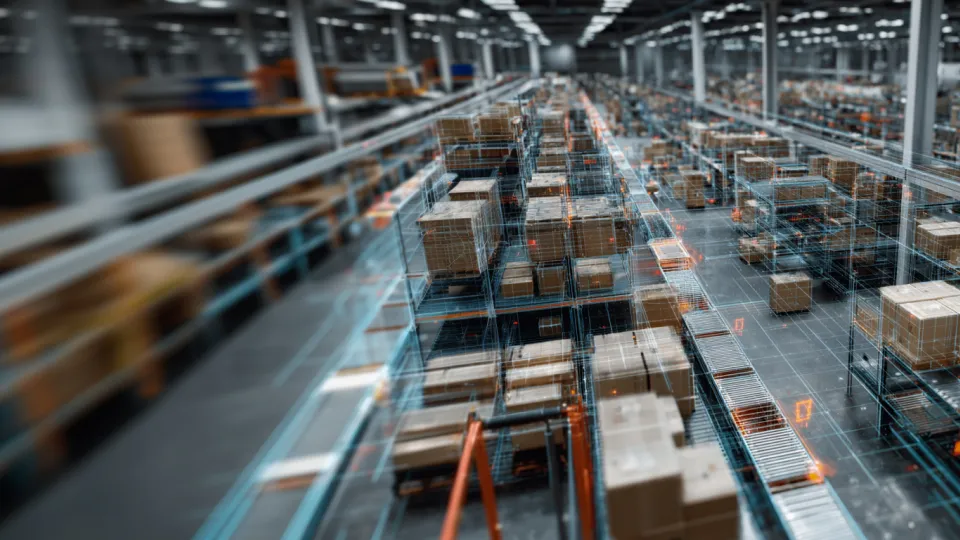
- A warehouse model that includes storage locations, picking routes, staging areas, and packing stations
- A supply chain model that spans suppliers, plants, distribution centers, and transportation lanes
System twins help decision-makers see how local changes ripple through the whole operation, whether that’s a layout tweak on the warehouse floor or a disruption at one supplier. They are often used to evaluate “what if” scenarios and understand network-level trade-offs before changing physical operations.
Business value and use cases of digital twins
Organizations invest in digital twins for a straightforward reason: they replace guesswork with data-driven certainty. Rather than testing changes on live systems or waiting for equipment to fail, teams can simulate scenarios, predict outcomes, and validate decisions before committing resources or risking disruption. This capability translates into measurable improvements across cost, speed, quality, and resilience.
Predictive maintenance and reduced downtime
Unplanned downtime is expensive. When critical equipment fails unexpectedly, organizations face not just repair costs but lost production, delayed orders, and cascading effects across operations. Digital twins shift maintenance from reactive or schedule-based to predictive, using continuous monitoring and analytics to spot problems before they become failures.
The twin tracks real-time signals like temperature, vibration, pressure, and operating cycles. When patterns deviate from normal behavior, anomaly detection models flag the issue and forecast how long the equipment can safely run before intervention is needed.
Maintenance teams can then schedule repairs during planned downtime windows rather than scrambling to respond to breakdowns. Predictive maintenance capabilities built on digital twin foundations help organizations reduce maintenance costs by up to 40% while extending asset uptime.
Faster innovation through virtual validation
Bringing new products to market traditionally requires multiple rounds of physical prototyping, each iteration adding weeks or months to development timelines. Digital twins compress this cycle by moving much of the testing and validation work into virtual environments.
Engineers create a digital replica of the product, then simulate how it behaves under different loads, temperatures, environmental conditions, and usage patterns. If a design weakness appears in simulation, the team can adjust parameters and retest immediately without waiting for a new prototype to be manufactured.
Organizations deploying digital twins report a 50% faster time-to-market and a 60% reduction in manufacturing project setup time. Manufacturers can slash time to market by half while reducing the number of physical prototypes from multiple iterations to just one.
This same pattern applies to production systems. Before reconfiguring a line or deploying new automation, teams build a virtual replica, test the changes, and validate that the new setup performs as expected. Only then do they touch the physical environment.
Process optimization and efficiency gains
Many operational inefficiencies are invisible until you model the whole system. Digital twins surface hidden patterns by capturing how work actually flows, not how it is supposed to flow under plans or procedures.
For instance, a twin might reveal that a production line spends 30% of its time waiting for material handoffs, or that a warehouse layout forces pickers to travel twice the necessary distance because high-demand items are stored far from packing stations.
Once these bottlenecks are visible, teams can test alternative configurations virtually by rearranging workstations, adjusting scheduling rules, and reallocating resources. The key is testing multiple scenarios without disrupting live operations. Teams can simulate what-if questions, like what happens if demand spikes 20% or what if a supplier’s delivery is delayed by two days, and compare outcomes before making any physical changes.
Organizations that implement supply chain optimization solutions using digital twins typically see productivity improvements of 15% to 30%.
Risk reduction and safer operations
Digital twins create a safe space to test high-risk changes. Whether it is validating a new control algorithm, training staff on emergency procedures, or stress testing a system under extreme conditions, the virtual environment absorbs the risk while teams learn what works.
This applies to both design and operations. During development, engineers can push a product beyond its normal operating range to find failure points without destroying expensive prototypes. In operations, teams can simulate equipment malfunctions, supply disruptions, or demand surges to understand how the system responds and where interventions are needed. If a proposed change creates unexpected problems in the twin, it never reaches the physical world.
In hazardous environments such as chemical plants, energy infrastructure, or construction sites, digital twins also support safety training. Operators can practice responding to dangerous scenarios in a virtual replica where mistakes have no real-world consequences.
Supply chain and operational resilience
Supply chains and operational networks are complex, interconnected systems where small disruptions in one area can cascade into major problems downstream. Digital twins help organizations see these dependencies, model disruption scenarios, and build resilience before crises hit.
A system twin of a supply chain and inventory might include suppliers, manufacturing facilities, distribution centers, transportation routes, and inventory policies. When a supplier signals a delay or a facility faces a quality issue, the twin simulates how that event propagates through the network: which products will be short, which customers will be affected, and which alternative suppliers or routes could absorb the gap. Decision-makers can evaluate trade-offs, such as faster shipping at a higher cost versus delayed delivery, and choose the option that best balances service levels, cost, and risk.
Companies using supply chain digital twins have reduced transportation costs by up to 10% while increasing on-time delivery rates by up to 20%. This same logic applies within facilities. A factory or warehouse twin shows how disruptions in one area affect overall throughput, helping teams prioritize interventions and allocate resources where they have the greatest impact.
Digital twin technology stack
Digital twins run on a layered technology infrastructure that connects physical sensors to cloud analytics and turns raw signals into actionable intelligence. While Section 2 explained the conceptual components (physical entity, virtual model, connection layer, intelligence), this section briefly outlines the technology layers that implement those concepts.
From edge to cloud
Digital twin platforms span three distinct processing tiers:
- Edge layer: IoT sensors, gateways, and edge devices capture data at the source. Local processing handles time-sensitive analytics, filters noise, and maintains operations during connectivity gaps.
- Cloud platform layer: scalable storage (data lakes, time-series databases) and processing engines handle ingestion, transformation, and historical analysis. This is where data from thousands of sensors gets structured for analytics and machine learning.
- Hybrid orchestration: IoT platform architectures coordinate how workloads split between edge and cloud, balancing latency requirements against computational capacity.
Intelligence and analytics
The intelligence layer is where a digital twin moves beyond mirroring into thinking. AI and machine learning models in digital twins operate across the stack, analyzing the continuous data streams that flow between physical and virtual systems to detect patterns, predict outcomes, and recommend actions.
Capability | Role in the digital twin |
Anomaly detection | Identifies when sensor readings deviate from the twin’s expected behavior model, flagging emerging issues in real time at both edge and cloud |
Predictive analytics | Uses historical and live twin data to forecast equipment degradation, demand shifts, and process failures before they occur |
Optimization engines | Runs simulations within the twin to compare scenarios and recommend parameter adjustments that balance competing objectives |
Agentic AI | Automates investigation workflows, connects findings across the twin’s data sources, and provides prescriptive guidance to operators |
What makes this different from standalone analytics is the closed loop. AI models don’t just analyze data in isolation. They operate on the digital twin’s continuously updated state, test recommendations against the virtual model, and feed validated actions back to the physical system. IoT Control Tower platforms bring these capabilities together, combining equipment monitoring with root cause analysis and AI-driven guidance within a unified twin environment.
Simulation and visualization
Physics-based simulation engines validate changes before physical deployment. 3D environments powered by platforms like NVIDIA Omniverse allow engineers to model robotic movements, test assembly sequences, and optimize factory layouts in virtual space. Contextualization tools like Azure Digital Twins and AWS TwinMaker map relationships between assets, processes, and business data, transforming isolated metrics into coherent operational models.
Integration and standards
Connecting legacy industrial systems, modern cloud platforms, and real-time sensors requires protocol translation (e.g., MQTT, OPC UA, Modbus) and data harmonization. Security runs across all layers through authentication, encryption, role-based access control, and audit logging. The goal is to create a unified view in which the physical and virtual worlds remain synchronized without constant manual intervention.
Digital twin applications across industries
Digital twins adapt to industry-specific challenges, data availability, and operational complexity. What works for a manufacturing plant looks different from what works for a retail store or a pharmaceutical facility. This section shows how organizations apply digital twins to solve domain-specific problems.
Manufacturing
Manufacturing was an early adopter of digital twin technology, and the applications continue to deepen. One of the most impactful uses appears in production planning, where manufacturers need to balance machine capacity, material availability, and delivery commitments without creating bottlenecks or idle time.
Scheduling systems now model entire factory layouts, analyze equipment states in real time, and generate optimized schedules that can be tested in physics-accurate simulations before going live. This lets teams see exactly how automated guided vehicles will move, where machines will transition between jobs, and whether the plan actually works. Some manufacturers achieve 95% utilization this way by catching problems in the virtual environment first.
When multiple robots work in the same space, coordinating their movements becomes another layer of complexity. Assembly-line twins let engineers test task sequences and motion paths in a virtual workcell, develop computer vision systems using virtual cameras, and refine workflows before the physical line ever runs. This reduces commissioning time and avoids costly mistakes that would otherwise occur during production.
Quality control is another area where digital twins compress timelines. Inspection systems that once took days to program can now generate optimal inspection routes in minutes by modeling component geometry and automating toolpath creation. The twin ensures full coverage of critical surfaces, such as welds and joints, while minimizing cycle time, turning what used to be a manual planning exercise into an automated workflow.
Supply chain and logistics
A supply chain digital twin models interactions across facilities, transportation networks, and inventory policies. They help organizations balance cost, speed, and resilience in environments where disruptions are frequent and costly.
Warehouse operations: Intralogistics optimization uses system-level twins to analyze flow patterns, identify bottlenecks, and test layout configurations before making physical changes. A comprehensive virtual replica simulates different slotting strategies, such as grouping frequently co-purchased items or moving high-demand SKUs closer to packing stations, and then measures their impact on travel time, throughput, and labor costs. This approach reduces order picking time and accelerates fulfillment as demand patterns shift.
Network optimization: Supply chain twins for automotive aftermarket operations balance inventory across warehouses, distribution centers, and retail locations. Digital twins of warehouse operations, combined with demand sensing and optimization solvers, enable distributors to simulate layouts, validate changes virtually, and predict delivery dates across multiple carriers and regional variables. Organizations report picking time reductions of 23% and improved inventory allocation across complex networks.
Automotive
Automotive manufacturers use digital twins across the value chain, from vehicle design through production and distribution. The complexity of automotive supply chains, with thousands of parts from hundreds of suppliers, makes system-level twins particularly valuable.
Automotive supply chain optimization shows how twins coordinate assembly lines, warehouses, and transport carriers to reflect the behavior of a full production and distribution ecosystem, helping manufacturers respond to disruptions and balance network-wide trade-offs.
Retail and customer experience
Retail digital twins model both physical spaces and customer behavior. Store layout twins test merchandising changes, traffic flow, and product placement before rearranging displays. Customer digital twins go further, creating virtual representations of individual shoppers to personalize experiences and predict behavior.
Autonomous agent-driven shopping experiences combine consumer and product digital twins with real-time context like pricing, inventory, and promotions. AI agents use these twins to guide customers through personalized journeys, recommend products based on preferences and purchase history, and adapt to changing needs mid-conversation. Organizations implementing these approaches report cart conversion increases of 30% and higher customer satisfaction through contextually relevant interactions.
Retailers also use digital twins for demand forecasting, virtual try-on experiences, product discovery, and store performance simulation. Studies show that virtual try-on capabilities powered by digital twins can increase conversion rates by up to 200% and boost buyer confidence by 56%.
Financial services
Financial institutions apply digital twin concepts to model portfolios, simulate risk scenarios, and optimize treasury operations. A digital twin of a loan portfolio can simulate how interest rate changes affect credit risk, helping banks proactively adjust lending strategies. Banks create virtual representations of entire institutions, like mapping assets, liabilities, and market positions, to test resilience under different economic scenarios, from market crashes to regulatory changes.
Treasury management twins provide real-time visibility into cash flows and liquidity positions, allowing teams to simulate cross-border transactions and optimize working capital allocation. Unlike manufacturing twins that sync with physical sensors, financial services twins integrate with transaction systems, market feeds, and risk models to create process twins that continuously stress-test financial operations.
Pharmaceutical and life sciences
Pharmaceutical manufacturing involves biological processes where small parameter changes can significantly affect product quality. Process twins model fermentation, purification, and formulation steps, simulating how adjustments to temperature, pH, or feed rates influence yield and batch consistency. This supports Quality by Design principles, where processes are optimized during development rather than corrected during production.
When real-time monitoring detects deviations from expected ranges, the twin compares current data with established benchmarks and recommends corrections before quality is affected. Organizations using this approach report reduced cycle times, less waste, and lower compliance risk. Drug development benefits too, with twins simulating clinical scenarios and predicting patient responses to optimize dosing strategies before physical trials begin.
Multimodal AI applications are increasingly integrated into these systems, combining data from imaging, sensors, and lab results to give process twins a richer context for decision-making.
Getting started – Challenges and considerations
Digital twins are not single deployments but evolving capabilities. Organizations that succeed treat them as living systems requiring strong data foundations, iterative refinement, and cross-functional alignment. Starting small and expanding based on proven value beats ambitious projects that stall before delivering results.
Key considerations
Area | What to address | Why it matters |
Data foundations | Ensure sensors deliver reliable, consistent data before building models | Twins are only as accurate as the data feeding them. Poor data quality undermines every downstream decision. |
Integration complexity | Map existing systems (PLCs, ERP, MES) and plan for protocol translation | Most environments mix legacy and modern systems. Getting them to share data requires deliberate architecture work. |
Cross-functional ownership | Involve operations, engineering, IT, and maintenance from the start | Digital twins cross traditional boundaries. Without shared ownership, adoption stalls at departmental walls. |
Model maintenance | Plan for continuous validation and recalibration as physical systems change | Twins drift out of sync with reality over time. Regular updates keep models accurate and useful. |
Scope management | Start with one high-impact use case before expanding | Trying to model everything at once leads to projects that never finish. Narrow focus builds momentum. |
Practical starting points
Choose a use case where value is obvious and measurable: a production line with chronic bottlenecks, equipment with high maintenance costs, or a warehouse struggling with fulfillment speed. Document current baselines so improvements become visible. Success with one twin builds organizational confidence and justifies broader investment.
Assess readiness across a few dimensions before selecting tools or platforms. Do existing sensors provide reliable real-time data? Can the current infrastructure handle time-series data at scale? Are teams comfortable with predictive analytics? Gaps in these areas often matter more than visualization capabilities.
Building for evolution
Digital twins mature over time. Early versions might focus on monitoring and visibility. Later iterations add predictive analytics, simulation capabilities, and eventually prescriptive guidance through agentic AI systems that recommend actions automatically. Plan architecture to accommodate this progression rather than rebuilding from scratch at each stage.
The organizations seeing the strongest results treat digital twins as operational infrastructure, not one-time projects. They establish feedback loops between virtual predictions and physical outcomes, retrain models as conditions change, and expand scope only after demonstrating value in narrower applications. That discipline, more than any specific technology choice, determines whether digital twin investments pay off.